Showing posts with label shrub. Show all posts

Wednesday, December 22, 2010

Preservation of bird life through tree planting


If you own a garden which borders a road which is higher than your land which is common across Spain; you can have a significant impact on the preservation of the neighbourhood bird-life by planting tall shrubs or trees along your perimeter.

The effect of the planted material is that the birds are forced to climb higher on take off enable them to cross roads without being struck by traffic.

The trees and shrubs are often used as visual and noise screening but if the boundary is a little further off it can be overlooked.

Tuesday, September 22, 2009

Mediterranean Garden plants

The evergreen Rosebay or Nerium Oleander (Apocynaceae) is the foundation plant of our garden continuously displaying a wealth of pretty funnel shaped flowers in various shades according to the variety. We have also planted a variegated form with cerise coloured blooms, and have placed it in front of climbers with darker green foliage. Throughout the Costa Brava in particular and the Ált Emporda district as a whole, this dependable plant is often used to screen boundaries as a hedge or also as a feature shrub in its own right.

Dependably hardy down to – 10° C. once established, the Oleander will thrive in any Mediterranean Garden. And will create an impressive shrub up to 3m high and 4m wide. The willow like leaves, sage green coloured with a silver underside, rustle like paper in the winds that shape this land; and with a little water during the flowering stage Oleanders will largely take care of themselves. Tip pruning will create a bushy shrub and removal of the seed pods will prolong the flowering period. It can be shaped easily and soon recovers from over enthusiastic clipping.

If you want to propagate this species then seeds are easily germinated in the springtime though the colours of the flowers may vary from the parent plant. Summertime will produce semi ripe wood ideal for cuttings, our friend Gabby recommends taking longer cuttings which she says root quickly.

All parts of the plant are poisonous to both humans and animals so care must be taken when planting Oleanders in your garden; as is the case with many other plants. Don't let that dissuade you from planting this pretty Mediterranean shrub which is the perfect flowering shrub in all other respects.

Wednesday, April 08, 2009

Tool tips for Spring.

Many gardeners will be admiring the display of spring flowering shrubs in the coming weeks. Those blooms are the result of careful pruning of the shrub following the flowering period, and because the sap is rising at this time of year the tools you use to maintain the form of your shrub soon becomes sticky with sap which can spoil the cutting action.

Essential garden tools like pruning shears or secateurs benefit from frequent cleaning and sharpening which will prolong the life of the product; as well as ensuring that plant material is cut cleanly and therefore minimising the risk of disease affecting your plant. My own choice is the Felco Brand.


The company website produces a useful guide to dismantling and servicing their products which
can be found on the web site.


Friday, January 02, 2009

January tasks for the Mediterranean gardener

New Year tasks for the Mediterranean gardener.

January has brought cold Siberian winds to the garden as 2009 dawns. The early morning frosts have been a welcome blow against the Tiger Mosquito which tried to establish itself in L’Alt Empordà during the warmer summer days; the eradication initiatives in the coastal plain seem to be effective, though it seems colonies may persist in the south of Girona province.

 Now it is time to deal with Garden jobs for January.

  • Large Trees should by now of been pruned to shape. Timber from those trees should be cut and stacked in dry airy conditions to provide firewood for the cold spell next year. If you try to burn the freshly cut wood it will fill your house with smoke and provide little heat.
  • Shrubs too should be cut back to stimulate fruit production and flower buds where that occurs on new seasons growth. Chop up the cut branches and leaves and incorporate them into your compost heap.
  • Compost heaps will benefit from being turned to introduce a little air into the material, ensure the heap is damp and firm down to stimulate the biological action. Dry material will not decompose.
  • Worm activity falls off as the temperature declines and frost can kill those valuable garden friends. Place your wormery in a sheltered spot and consider insulation to maintain temperature. Remember to keep the bed damp but not wet and feed the worms.
  • Cultivation - Rainfall rare as it has been has softened the earth and will provide an opportunity to cultivate the soil. Bed preparation will be assisted by any frost which will break down soil with higher clay content.
  • Compost from the previous year’s heap should be added to freshly dug ground where it can be dug in to help boost soil fertility.
  • Mulch - Heavy rain such as we experience here in our particular Mediterranean Garden can compact the soil quite badly. A heavy mulch of fibrous compost from our heap helps to minimise the damage and the worms will pull the material into the soil.
  • Bamboo canes are grown as windbreaks throughout Spain they are plentiful and the canes can be cut and dried for a supporting role in your garden. The bamboo wood is easier to make holes in whilst still fresh so if you need to add holes for wires and fixings do it as soon as you have harvested the bamboo.

Friday, May 16, 2008

Photina - Pretty as a picture!


Photina Red Robin is looking its best at the moment the exuberance of that glossy red foliage is complemented by the delicate sprays of its white flowers. Older leaves turn bright green but the plant will continue to sprout young red foliage if lightly pruned to shape.

Over planting of the Photina in municipal displays led to a fall in popularity in some quarters , though it seems to be an ever present in the garden nursery. Either as a specimen or as part of a shrubbery  if you have the space and the conditions then the Photina will light up your garden. 

Sunday, March 02, 2008

Cometh the hour


Planting new shrubs and bulbs may be a bit precarious given the rain situation but the time is now if they are going to survive at all. Transition from cold dry winter to a hot humid spring is rather demanding on the new plants meagre resources, and the change is sudden and dramatic.

Seeking out plants that seem to do well in the neighbourhood is good general advice for the gardener. One of the plants that stands the hot dry summers and always produces a mass of tiny pink blooms is the Tamerisk. Though I have read that in some parts of the USA it is considered an invasive species that damages the local wild habitat.

In our hurry to establish a new garden it is often tempting to strive for an instant effect, and therefore plant larger specimens; though often stronger plants with good form are the result of planting smaller examples and growing them on. There is a particular satisfaction to be gained from watching a garden develop.


Saturday, December 22, 2007

Foliage in the Garden

Cupresses Arizonica


With many garden flowers faded like those summer days the importance of foliage in the planting scheme is ever more apparent.


Coloured leaves which intensify or change their hue change dramatically the aspect of any garden.


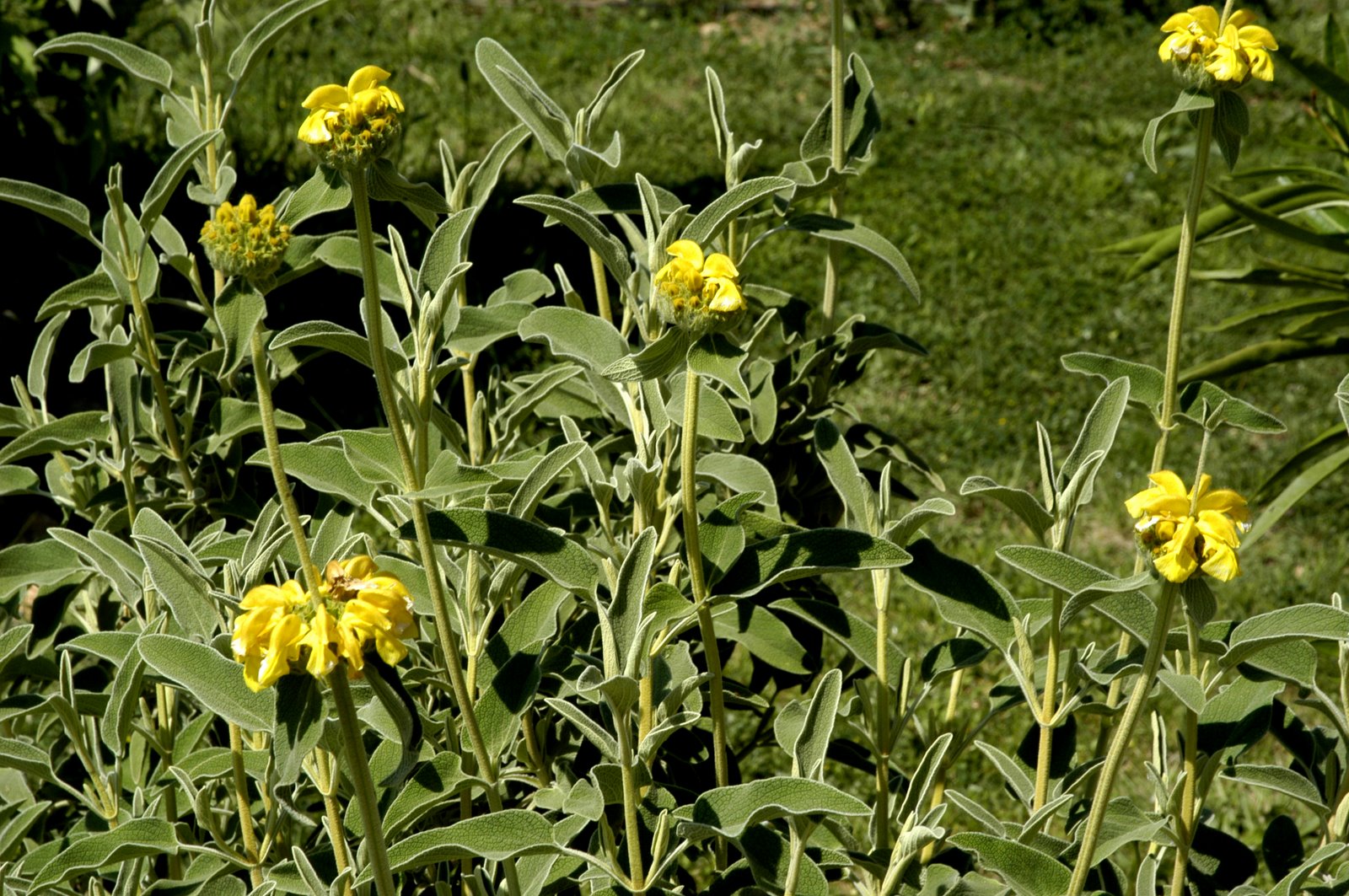
Jerusalem Sage
Leaves of many Mediterranean plant species have hairy leaves which serve to reflect the sun and also capture moisture from the humid air. Their texture contrasts sharply with glossy leaved varieties.

Sunday, December 02, 2007

Phlomis lanata - Jerusalem sage


Phlomis lanata or Jerusalem sage was an introduction to the garden this year it's sage coloured leaves are hairy like many Mediterranean plants a useful mechanism for capturing moisture when the humidity is high. Although this is a tough plant and can tolerate the hottest and driest conditions it is none the less a showy plant with many bright yellow blooms. The flowers which appear in two stages are held above the plant by almost leafless stems. First a ruffled collar of flower blossom opens, the stem continues to grow several inches before producing a more compact flower at the shoot tip. This plant is attractive to pollinating insects too.

Thursday, April 27, 2006

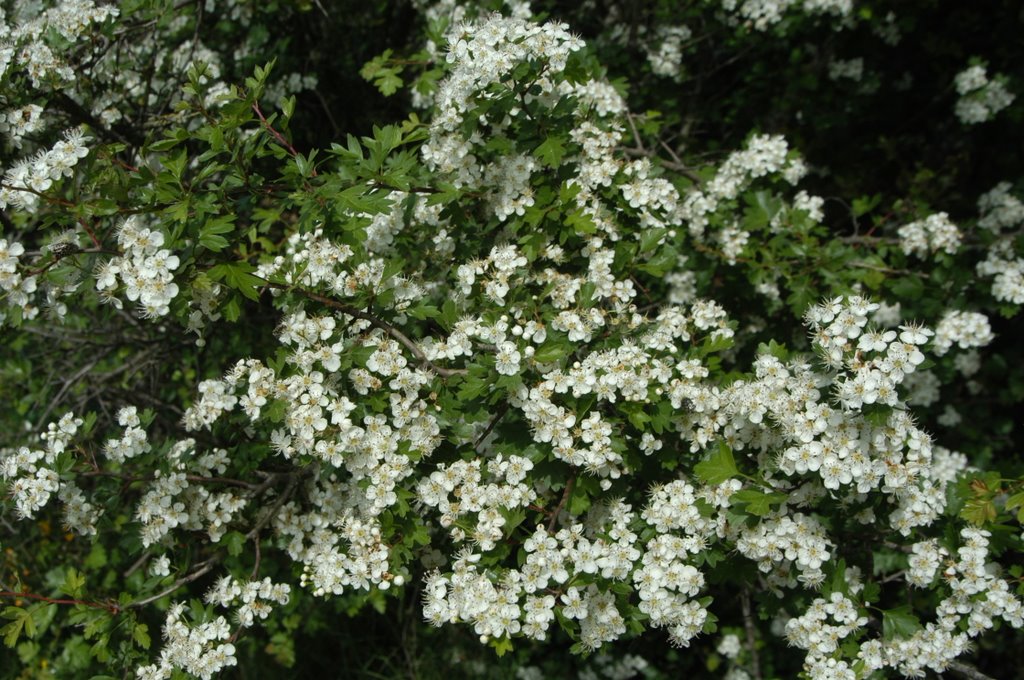
Crown of Thorns


Hawthorn and Blackthorn are two of the spring's heralds, once they bloom you can be sure that 'primivera' has arrived.

This photograph is of a hawthorn which suffered badly in last years drought though now looks to be fully recovered.

Often used as a hedging plant it also makes an excellent tree, the pink form being particularly striking.