

Showing posts with label Nerium Oleander. Show all posts
Showing posts with label Nerium Oleander. Show all posts
Wednesday, September 23, 2009


Tuesday, September 22, 2009
Mediterranean Garden plants
The evergreen Rosebay or Nerium Oleander (Apocynaceae) is the foundation plant of our garden continuously displaying a wealth of pretty funnel shaped flowers in various shades according to the variety. We have also planted a variegated form with cerise coloured blooms, and have placed it in front of climbers with darker green foliage. Throughout the Costa Brava in particular and the Ált Emporda district as a whole, this dependable plant is often used to screen boundaries as a hedge or also as a feature shrub in its own right.
Dependably hardy down to – 10° C. once established, the Oleander will thrive in any Mediterranean Garden. And will create an impressive shrub up to 3m high and 4m wide. The willow like leaves, sage green coloured with a silver underside, rustle like paper in the winds that shape this land; and with a little water during the flowering stage Oleanders will largely take care of themselves. Tip pruning will create a bushy shrub and removal of the seed pods will prolong the flowering period. It can be shaped easily and soon recovers from over enthusiastic clipping.
If you want to propagate this species then seeds are easily germinated in the springtime though the colours of the flowers may vary from the parent plant. Summertime will produce semi ripe wood ideal for cuttings, our friend Gabby recommends taking longer cuttings which she says root quickly.
All parts of the plant are poisonous to both humans and animals so care must be taken when planting Oleanders in your garden; as is the case with many other plants. Don't let that dissuade you from planting this pretty Mediterranean shrub which is the perfect flowering shrub in all other respects.
Wednesday, March 11, 2009
Mediterranean plants and land restoration

A group of experts in Analytical and Environmental Chemistry, University of Sevilla (U.S.), along with researchers from the
Scientists have studied how adsorbed, ie attract-and retain 22 types of natural pesticides in ten, five organic waste (peanut shell, bamboo and olive stones, dates and avocado) and five leaves of plants ( Eucalyptus, horseradish, oregano, oleander and jara), which were previously crushed. The results of the study, published in 'Journal of Hydrology ", show that the remains of the dates and olives are an average value of adsorption of 93% and 90% respectively, and the leaves of the radishes and rockrose, of 80%.
"The direct application of natural organic adsorbents on farmland not only retains the pesticides and reduce their consumption, but also improve soil fertility," says Hicham El Bakouri, co-author of the study and researcher at the Department of Chemical Engineering and U.S. Environmental.
The Bakouri stressed that the addition of this organic material crushed to the ground also favors the biodegradation of contaminants, and to increase microbiological activity, reduce the vertical movement of pesticides from surface to groundwater. These waters are commonly used for irrigation and human consumption.
Wednesday, July 19, 2006
Moving plants
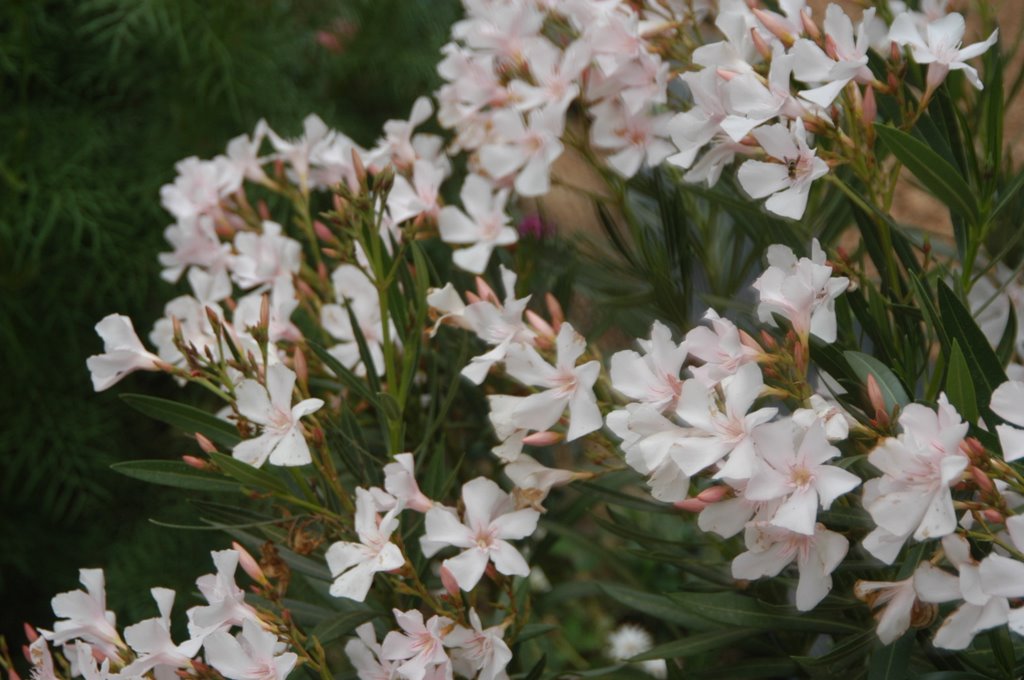
Nerium Oleanders are supposed to dislike disturbance. Last year I lifted a flowering 1.5 metre specimen which I divided into two and then relocated. The two new plants are thriving with a fantastic flower show this year.
Subscribe to:
Posts (Atom)