Showing posts with label Olive trees. Show all posts

Monday, December 07, 2009

Olive blossom

The olive trees finally produced fruit this year it is particularly rewarding after such a difficult time keeping them alive in the early years.

Spring time flowers on the olive tree are white and quite insignificant but each tiny bud holds the promise of a fruit maturing in the winter sun.

Our neighbours tell us that a major pest which can prevent the tree fruiting is the ant.

If you look carefully you can see the tiny olive blossom.

In this part of Spain nurserymen often quote the price of olive trees as €1 per year of growth; they will happily show you trees (they estimate) of 1000 years of age at the corresponding price of €1000.

We chose to grow our own from seedlings and now have small established trees.

Wednesday, March 11, 2009

Mediterranean plants and land restoration


A group of experts in Analytical and Environmental Chemistry, University of Sevilla (U.S.), along with researchers from the University of Abdelmalek ESSAADI (Morocco), has found that the remains of dates and olives, as well as the leaves of certain plants of the Mediterranean region, act as adsorbents of pesticides.

Scientists have studied how adsorbed, ie attract-and retain 22 types of natural pesticides in ten, five organic waste (peanut shell, bamboo and olive stones, dates and avocado) and five leaves of plants ( Eucalyptus, horseradish, oregano, oleander and jara), which were previously crushed. The results of the study, published in 'Journal of Hydrology ", show that the remains of the dates and olives are an average value of adsorption of 93% and 90% respectively, and the leaves of the radishes and rockrose, of 80%.

"The direct application of natural organic adsorbents on farmland not only retains the pesticides and reduce their consumption, but also improve soil fertility," says Hicham El Bakouri, co-author of the study and researcher at the Department of Chemical Engineering and U.S. Environmental.

The Bakouri stressed that the addition of this organic material crushed to the ground also favors the biodegradation of contaminants, and to increase microbiological activity, reduce the vertical movement of pesticides from surface to groundwater. These waters are commonly used for irrigation and human consumption.


Thursday, January 01, 2009

Arbolé, Arbolé - Tree Tree

Arbolé, Arbolé

Tree, tree
dry and green.

The girl with the pretty face 
is out picking olives. 
The wind, playboy of towers, 
grabs her around the waist. 

Four riders passed by
on Andalusian ponies, 
with blue and green jackets 
and big, dark capes. 
"Come to Cordoba, muchacha." 
The girl won't listen to them.
 
Three young bullfighters passed, 
slender in the waist, 
with jackets the color of oranges 
and swords of ancient silver. 
"Come to Sevilla, muchacha." 
The girl won't listen to them. 

When the afternoon had turned
dark brown, with scattered light, 
a young man passed by, wearing 
roses and myrtle of the moon. 
"Come to Granada, inuchacha." 
And the girl won't listen to him. 

The girl with the pretty face
keeps on picking olives 
with the grey arm of the wind 
wrapped around her waist.
Tree, tree
dry and green.

Federico 
García
 Lorca

Wednesday, December 17, 2008

OLEOTEC - 2009 Zaragoza


OLEOTEC

Olive Growing Equipment and Techniques Show

Zaragoza, Spain

10. February - 13. February 2009


Friday, December 05, 2008

Olive and Hypertension

The leaves of the olive tree have been used for medicinal purposes since ancient times, and modern lab research suggests that olive leaf extracts have antibacterial, anti-inflammatory and antioxidant actions. There is also evidence that the extracts have properties that could lower blood pressure.

The current study, published in the journal Phytotherapy Research, included 20 sets of identical twins with "borderline" hypertension -- blood pressure that is above the optimal level of 120/80, but below the cutoff of 140/90 used to diagnose high blood pressure.


Tuesday, November 04, 2008

Olive stone fuel

The Spanish Journal of Chemical Technology & Biotechnology carries a report from the ongoing studies by scientists working at the Universities of Granada and Jaen. Their research project was to prove that the four million tons of olive stones, which are a waste product from the Spanish olive oil production, could be processed into bio-diesel.

This research would have implications for other countries throughout the Mediterranean region. Planting of olive trees would once again be encouraged, if the process is shown to be viable.

Unlike corn / maize grown for fuel production this method does not detract from food programmes and would have less negative impact on the landscape.
The researchers estimate that each 100kg. of stones could be converted to 5.7kg. of ethyl alcohol.

Thursday, March 06, 2008

A Mediterranean garden in the Languedoc

We would like to introduce our blog readers to a new blog about garden and horticulture in a Mediterranean climate. The blogger in this instance is chaiselonge who has written  this guest blog by way of introduction.


A Mediterranean garden in the Languedoc


I grew up in Mediterranean countries, in North Africa and in Turkey, among olive trees, eucalyptus, oleanders and hillsides covered in thyme and rosemary.  After spending many years in Wales I persuaded Lo Jardinièr (the gardener, in Occitan) that I need to live where olive trees grow.  So now we're learning to garden in a Mediterranean climate and we've planted two small olive trees which will probably look lovely in 100 years' time.  Last autumn we harvested 24 black olives.  I followed the recipe for preserving them given by Tomás Graves in his book, A Home in Majorca, soaked them in spring water for a few days, then layered them with herbs in an earthenware jar and covered them with brine.  Two months later on Christmas day our son and daughter were here and the four of us shared them with aperitifs in the garden in the sun.


In our medieval village there isn't room for gardens around the houses, so for centuries the villagers have gardened on the hillside, using water from the spring at the top.  We've bought a plot there and in this small space we're hoping to create a mixed garden of vegetables and ornamental drought-resistant Mediterranean plants and to enjoy eating the food that we grow there and I'll be blogging about our progress.  We've got a lot to learn, but we get help from our neighbours and benefit from the experience that has been passed on through the generations here.  And best of all, we've got the produce.  This winter we've been eating our way through 50 jars of preserved tomatoes, full of the taste of summer heat.  We need never buy a tin of tomatoes again!

 chaiselongue,

Please visit my garden -

Friday, June 15, 2007

Farming Malarkey

This Farming Malarkey is not as easy as it appears.

Chances of a fig from Figueres are looking quite slim at the moment, with little evidence of fruit having formed on our lone fig tree. The tree looks healthy enough and has good leaf coverage after the late winter rainfall. I enjoy the figs direct from the tree for the freshest of tastes or served with the Iberian ham of Spain’s signature dish. Carol prefers dried figs and lunches on them almost daily with Fazia her friend and fellow fruit-bat. We dried out the figs produced in 2005 and 2006 using a combination of sunshine and the low heat of an oven. In the short term the jammy dried figs were a success but they did not store well.

Pruning carried out by us and as advised by our Moroccan tiler friend was light and should not have damaged the fruit production; further pruning as performed by Francisco’s sheep has only refined the shape of the fig. It is I suppose possible that the previous year’s drought has stopped this year’s fruit from developing on the fig tree. On a positive note there are tiny fruit buds that have set and will go on to produce next season’s fruit. The abundance of fig leaves means that we will have to seek out recipes which use those leaves. Any leaves that remain could be supplied to the naturists who cavort upon the Costa Brava beaches.

Our solitary almond tree survived the drought despite some pillock having excavated the embankment on which it stands. The guy who sold us the house had dumped his manure pile on the embankment, and somebody had dug out the stash whilst we were away from the property. The tree had only four nuts this year but a crop is a crop is it not? Now though that crop has been decimated by either weather or predator and only half the nuts remain.

The pomegranate tree we planted two years ago is flowering again but alas it has not provided us with any fruit to date. Last year I struck half a dozen cuttings from the original tree and although they are now thriving they are not yet flowering. As they mature and flower cross pollination should ensure a healthy crop.

The olive cuttings are now established young plants though their shapes are wildly different. One is almost a standard whilst the others savaged by the severe weather are shrubbier. Pruning should sort out the shapes and we will try to propagate the material we have to remove. Who knows in a thousand years or so they may all be beautiful old trees.

Sunday, December 10, 2006

Burning Issues

Fire wood doesn’t grow on trees at least not the protected trees of the bosque around the finca. Only those broken braches which have been torn from the trees by the Tramontana winds may be gathered. The whole village it seems is on permanent alert for the sound of falling firewood.

The olive harvest is not going to be as productive this year due to the dry weather, though it is thought that the quality of olive oil pressed from the fruit will be high. After the harvest the boughs of the Olive trees will be cut back hard to encourage young growth which carries the fruit. Many a young farmer has spent happy hours entwined in the limbs of an elderly Olive because he will have two cash crops from his plantation, first of all the Olives themselves and then a little later firewood from his pruning.

Firewood at the retail level sells at around 3€ a small bag which will burn away within a couple of hours. Buying olive wood from farmers directly is difficult because they tend to have an established customer base which accounts for their entire crop. On a cold day it really warms your heart to see your neighbours taking delivery of a wagon load of fire wood, fuel which they will add to last years stack, whilst you continue to forage for windfalls.

Those of you like ourselves who originate from central heating and gas fire lands and have no real experience of real fires are in for another shock. Even if you are able to cut down a tree or two that wood will have to be stored for up to two years before it is dry enough to be usable. Heat given off by the wood varies too, blonde wood as the Spanish like to call it includes the wood of fruit trees as well as soft wood and gives a little over half the heat given off by a hardwood like oak.

In springtime I will prune back the Mulberry trees and add their wood to my stockpile and then dry it out for a year or two; unless I get paticularly cold in the meantime.

Due to the hike in bottled gas prices I have used half of my stored wood already. This store comprised of a gnarled old trunk pruned from the fig tree, windfalls as well as recycled window and door frames. There was also that old beam I found in the swimming pool along with the mumified cat! Oh and some accidental oak too! (Don't worry! The cat went into the compost heap!)

Saturday, November 11, 2006

Bend it like Beckham

I paid a visit to a specialist tree nursery near Bascara, a nursery which supplies the stock to the local garden centres and landscape companies. The owner made time to show me around his stock which was very impressive indeed. Pride of place went to the old gnarled olive
trees of course, those on sale for up to 1000€ each. He told me that as a rule of thumb the best trees were priced at 1€ per year of growth, pointing out well structured trees across the age ranges.

Olive trees so old as his finest stock were not bought for the number or quality of olives that they produced, but purely for aesthetic appearance, better olives came from much younger trees.

As we walked and talked he turned the conversation to football and of course to Barcelona. Then he asked me what I thought about David Beckham the Englishman playing for Barcelona's great rivals Real Madrid. This was obviously a trap, and I had to be careful because too much praise for 'El Beckham' and the price of my trees would surely go up. He agreed that Beckham was a good player but insisted that he would never match Ronaldinho

When I told him that I thought Beckham was a lot prettier than Ronaldinho, he laughed out loud and then whilst patting his cheek ever so daintily and suggesting vanity in his action said,

'Si,Si es muy guapo no'?

I was in dangerous territory here and turned the conversation back to the trees. Looking at my land and it's planting possibilities, he went on to suggest that I buy four trees at 1000€ and plant them across the finca; the rest of the 14,000 m2 area I should plant at 5 metre intervals with young trees for their more prolific crop. This he believed would really set of the villa and give me a useful income as well. I must have gone as white as Beckham's football jersey because he laughed again.

'Maybe in the future' he said adding 'poco y poco' (little at a time)

Poco y poco indeed.

Wednesday, September 06, 2006

The lonely almond tree


This is our solitary almond tree, although young it has survived last years drought. 

It did flower but did not set fruit.

Obviously a young plant trying to establish itself during the ongoing drought.

We were told that our land was cleared of fruit trees some years ago it does seem a waste to fell trees from the landscape.

Wednesday, April 05, 2006

Olive, alive, alive oh!


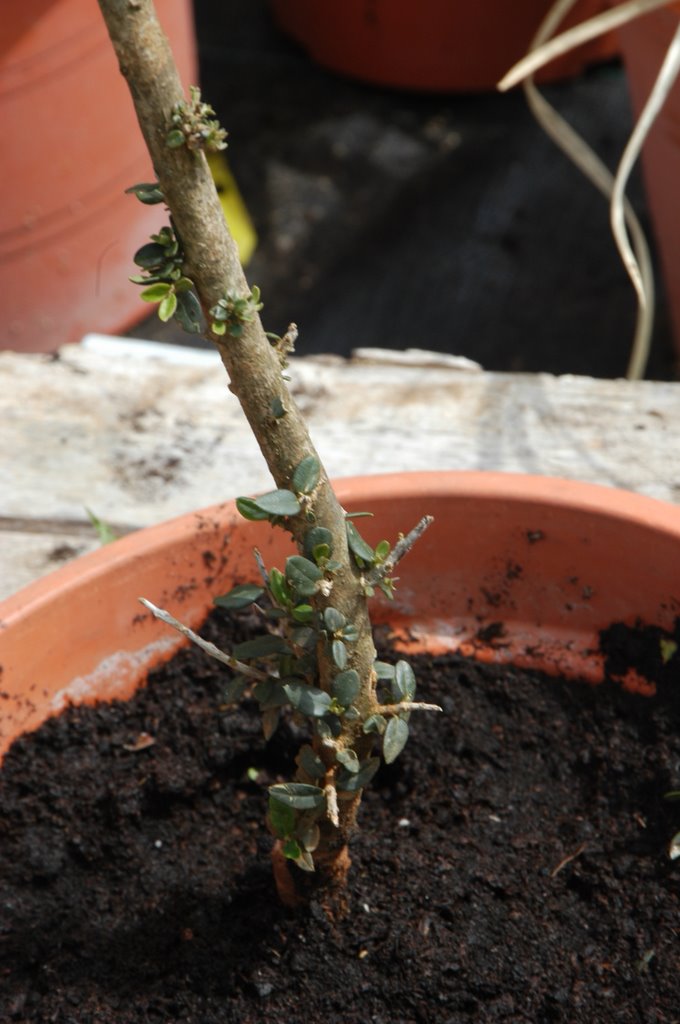
The young olive trees we planted last spring before the drought and watered all summer long; despite the long walk with the water barrow, are still alive but barely so. They were left to fend for themselves for the winter and suffered from the sporadic rainfall. I have therefore lifted them and will replant them nearer the house along with the pomegranate. Although both species are pretty tough once established they do need a bit of help at this stage.

Wednesday, May 19, 2004

The plot


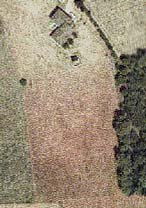
This old aerial photograph shows the plot with the house at the top of the picture and the land extending to the bottom of the photograph; and in particular shows how little cultivated area there is.
The dark circle to the left of the photograph is a solitary fig tree. The trees to the right are a mixture of oak, pine and the occasional olive tree. Everything else on the land is poorly maintained grassland or rock and weed.

Our Finca is surrounded on two sides by open farmland used for centuries to grow barley or ordi as it known in Catalan, the Spanish regional language. The views are tremendous, open fields dotted here and there with farm buildings yield to rolling tree clad hills, and eventually to the Pyranean mountain range beyond. Those mountains are still snow capped in late May.

We are beginning to wonder what we have taken on!