Showing posts with label Compost bin. Show all posts

Monday, December 27, 2010

Organic composting guide - online

If you are beginning composting or would like to understand what goes on in your heap an ebook


will help and guide you; in choice of materials,siting the heap and constructing a compost box. The guide will also inform you of the nutriment available to plants within your compost.

Friday, January 02, 2009

January tasks for the Mediterranean gardener

New Year tasks for the Mediterranean gardener.

January has brought cold Siberian winds to the garden as 2009 dawns. The early morning frosts have been a welcome blow against the Tiger Mosquito which tried to establish itself in L’Alt Empordà during the warmer summer days; the eradication initiatives in the coastal plain seem to be effective, though it seems colonies may persist in the south of Girona province.

 Now it is time to deal with Garden jobs for January.

  • Large Trees should by now of been pruned to shape. Timber from those trees should be cut and stacked in dry airy conditions to provide firewood for the cold spell next year. If you try to burn the freshly cut wood it will fill your house with smoke and provide little heat.
  • Shrubs too should be cut back to stimulate fruit production and flower buds where that occurs on new seasons growth. Chop up the cut branches and leaves and incorporate them into your compost heap.
  • Compost heaps will benefit from being turned to introduce a little air into the material, ensure the heap is damp and firm down to stimulate the biological action. Dry material will not decompose.
  • Worm activity falls off as the temperature declines and frost can kill those valuable garden friends. Place your wormery in a sheltered spot and consider insulation to maintain temperature. Remember to keep the bed damp but not wet and feed the worms.
  • Cultivation - Rainfall rare as it has been has softened the earth and will provide an opportunity to cultivate the soil. Bed preparation will be assisted by any frost which will break down soil with higher clay content.
  • Compost from the previous year’s heap should be added to freshly dug ground where it can be dug in to help boost soil fertility.
  • Mulch - Heavy rain such as we experience here in our particular Mediterranean Garden can compact the soil quite badly. A heavy mulch of fibrous compost from our heap helps to minimise the damage and the worms will pull the material into the soil.
  • Bamboo canes are grown as windbreaks throughout Spain they are plentiful and the canes can be cut and dried for a supporting role in your garden. The bamboo wood is easier to make holes in whilst still fresh so if you need to add holes for wires and fixings do it as soon as you have harvested the bamboo.

Wednesday, January 24, 2007

In the mix

A few years ago the local council of a neighbouring area, in an effort to promote the recycling of household waste decided to subsidise the provision of compost bins for domestic use. The uptake was disappointing but given the small gardens that most modern houses in the UK are provided with these days maybe it was not so surprising after all. As a result of this situation I was allowed to apply for a compost bin and shown several models to choose from. I chose the biggest although our household comprises of a couple Carol, and I. There was a stipulation that those who took part in the scheme should attend a one day seminar on composting and that after six months they should provide a detailed list of materials composted and submit this to the scheme administrator via a survey form. Not a lot to ask for a £50 subsidy.

The compost bin I chose was of a modular construction and made of recycled plastic, the walls of the bin were ventilated and double skinned insulating the compost with a later of air. The modules were each formed in 1m2 elements and stacked to form a cubic metre of usable space covered by a lid. Other composters expressed the doubt that we could fill such a bin.

Over the next few months all our fruit and vegetable waste, tea bags, lawn clippings, shredded newspaper were added to the bin. A garden shredder made short work of the tree and shrub prunings, all were added to the mix at first in layers and then later turned and mixed. When short of green material I would take my neighbours lawn clippings and use them to re-activate the heap.

When the survey form arrived I began to fill the form in. Quite straightforward really, the usual questions about the compost bin model, house occupancy etc. When it came to the ingredients of the home made compost mine probably differed from most of the other members; mine contained Blackbirds and thrushes killed by the neighbourhood cats. It also contained several Koi carp from my pond killed by Herons. Unfortunately I haven’t yet managed to add the Herons to the heap but I do live in hope.

The compost produced by the bin is of good quality, any small pieces of material that have not rotted completely go back into the mix for next year’s compost. And mix is the key if you turn the material to mix the contents then the heap rots down more quickly and there are no bad odours. Far from being too big for us I now have material kept in other containers waiting to be added to the heap.

When we bought the house the soil was heavy clay, we have been able to add our compost over the years which has rendered the heavy ground into a reasonable soil, though we do get a lot of cold wet days here.

Sunday, May 14, 2006

Compost - Heaps of fun


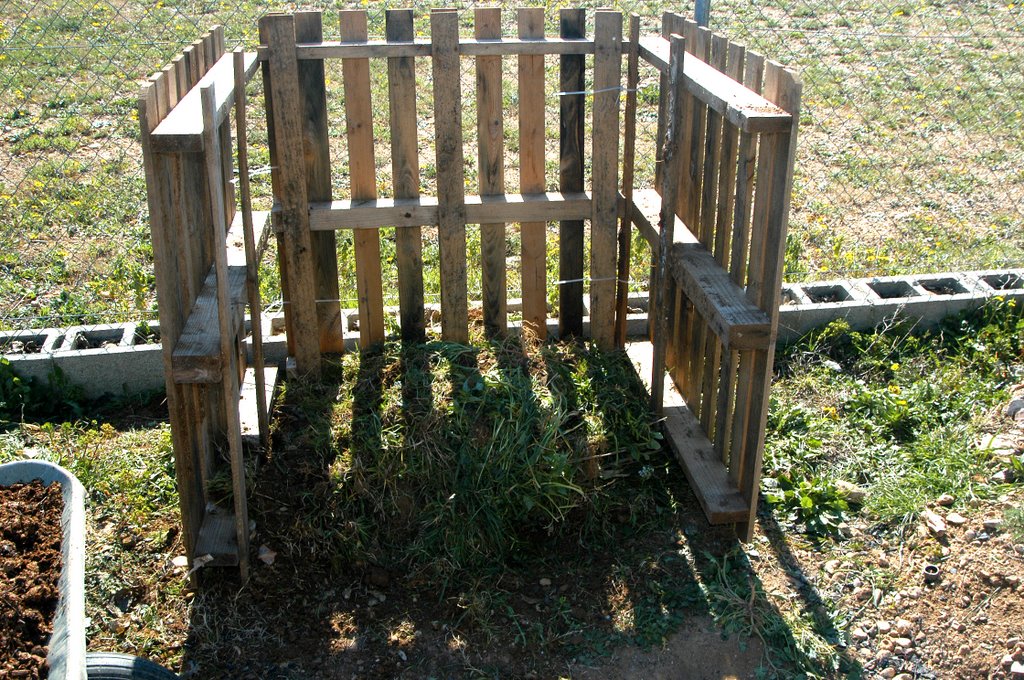
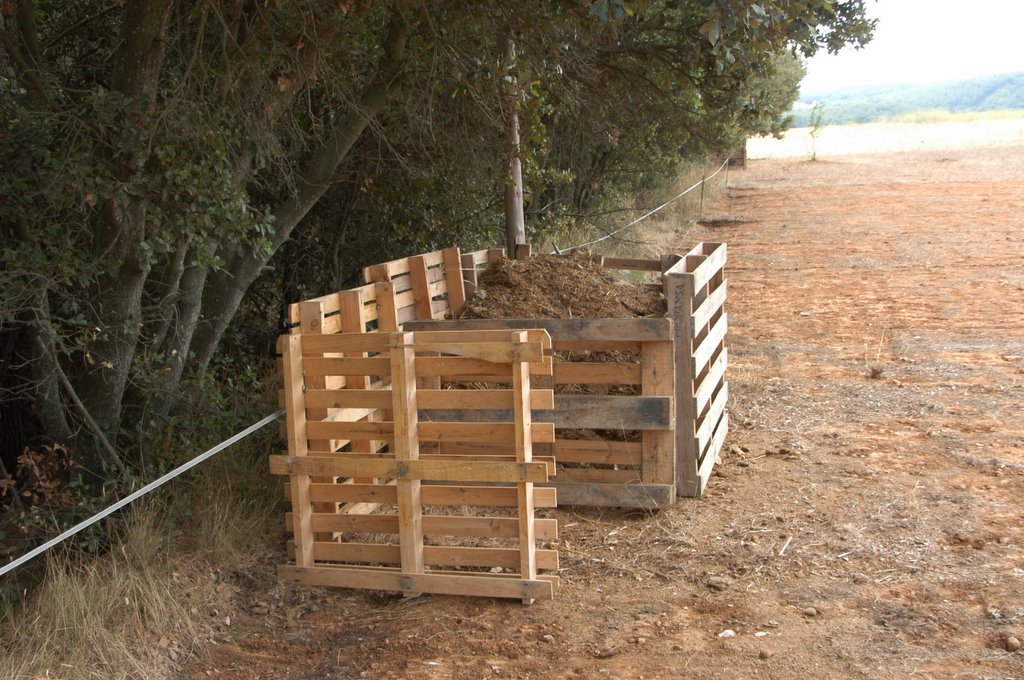
Wooden pallets form the bins for the composting process. With so little green material around even quite robust weeds are added having taken care to remove all the rootstock. 

Carol has got the hard work of cutting up all the foliage to fuel the process.

Tuesday, October 26, 2004

Compost


The pallets from the builders materials are utilized to build compost bins. The pallets are held together by plastic cable ties, the advantage of the ties is that the bins are easily taken part and moved around the plot.

We collect as much as we can of the horses droppings which littered the land and incorporate all of our waste vegetable matter. Without water the manure will take a long time to mature into useful compost. So we add water little by little and turn it every week by hand. Already change is apparent in the heap, but it is early days yet. I will have to search for an organic compost accelerator.

The only green matter we have is a little grass, and the leaves shed by the three as yet unidentified trees. The trees provided useful shade on the eastern terrace of the villa. The former owner of the house seemed to be describing a kind of fruit or nut, but there are no signs of a crop.

Whilst scouring the horticultural books on a cold dark autumn evening, I finally identify the three trees, they are Mulberry trees. Now what can you do with mulberry's? Is it warm enough here for a silk farm?