Showing posts with label Trees. Show all posts

Wednesday, December 22, 2010

Preservation of bird life through tree planting


If you own a garden which borders a road which is higher than your land which is common across Spain; you can have a significant impact on the preservation of the neighbourhood bird-life by planting tall shrubs or trees along your perimeter.

The effect of the planted material is that the birds are forced to climb higher on take off enable them to cross roads without being struck by traffic.

The trees and shrubs are often used as visual and noise screening but if the boundary is a little further off it can be overlooked.

Saturday, December 05, 2009

Pipe cleaner


Joseph and I spent hours trying to unblock the drain from the chacca. We found that roots from nearby tees had crept into the pipe work forcing the valve open just a little and costing us our rainwater. Joseph who is a retired engineer and keen fruit and vegetable grower, cleaned up and restored the old brass valve which controlled the flow to the pipe. Harvesting rainwater to feed our crops was again possible.

One day on our return to the Finca we found that the old brass valve had been stolen, and with it went our water supply once more. We have replaced the valve with a PVC unit no doubt the brass has been scrapped. What a waste!

Many of the gardeners in our and neighboring villages are suffering thefts of equipment, tools and crops.

Friday, January 16, 2009

Heritage trees


All over the country there are trees 
that have become part of our collective landscape heritage. 
They are usually either very large, or of extraordinarily beauty or age,
 and many are part of history and popular lore, 
having played a role in historical events, 
or figure in local stories and legends.


© 2009 Landscape Observatory of Catalonia / Hospici, 8 - 17800 OLOT - Tel: +34 972 27 35 64 - Fax: +34 972 27 15 89 -observatori@catpaisatge.net

Wednesday, January 14, 2009

How Popular is the poplar tree?

Investigators of the Higher Council for Scientific Research (CSIC) have succeeded in genetically modifying female Poplar trees for the decontamination of water and soil of the pollutant TNT (trinitrotoluene). This explosive, highly toxic and difficult to dispose of pollutant is a problem throughout large parts of Europe and the United States of America.

Deep rooted Poplar trees can reach down to aquifers to absorb water and pollutants deeper embedded in the land. Enzymes in the plant material converts the TNT in to a harmless substance mostly stored within the trees roots during their lifetime. Because the contaminant does not reach the leaf fallen leaves do not present a risk to grazing animals.Using female trees eliminates the risk of pollen from modified trees spreading to the wider environment. The decontamination process takes up to 15 years.

The highly explosive TNT is toxic to living organisms and very difficult to remove, there is no 100% effective method: 

"For the time is used excavation and incineration, an expensive and not very kind to the environment, "says Pieter van Dillewijn of the Experimental Station Zaidín. “There are other more economical methods such as composting, but its implementation is more limited and often without reliable data,” adds the investigator.

Once absorbed by the plant or when the tree dies the Dutchman believes that it would be necessary to remove the mature plant, including much of its roots, so the TNT or its derivatives do not return to the ground. Then incinerate the tree and thereby generate energy.

Friday, January 02, 2009

January tasks for the Mediterranean gardener

New Year tasks for the Mediterranean gardener.

January has brought cold Siberian winds to the garden as 2009 dawns. The early morning frosts have been a welcome blow against the Tiger Mosquito which tried to establish itself in L’Alt Empordà during the warmer summer days; the eradication initiatives in the coastal plain seem to be effective, though it seems colonies may persist in the south of Girona province.

 Now it is time to deal with Garden jobs for January.

  • Large Trees should by now of been pruned to shape. Timber from those trees should be cut and stacked in dry airy conditions to provide firewood for the cold spell next year. If you try to burn the freshly cut wood it will fill your house with smoke and provide little heat.
  • Shrubs too should be cut back to stimulate fruit production and flower buds where that occurs on new seasons growth. Chop up the cut branches and leaves and incorporate them into your compost heap.
  • Compost heaps will benefit from being turned to introduce a little air into the material, ensure the heap is damp and firm down to stimulate the biological action. Dry material will not decompose.
  • Worm activity falls off as the temperature declines and frost can kill those valuable garden friends. Place your wormery in a sheltered spot and consider insulation to maintain temperature. Remember to keep the bed damp but not wet and feed the worms.
  • Cultivation - Rainfall rare as it has been has softened the earth and will provide an opportunity to cultivate the soil. Bed preparation will be assisted by any frost which will break down soil with higher clay content.
  • Compost from the previous year’s heap should be added to freshly dug ground where it can be dug in to help boost soil fertility.
  • Mulch - Heavy rain such as we experience here in our particular Mediterranean Garden can compact the soil quite badly. A heavy mulch of fibrous compost from our heap helps to minimise the damage and the worms will pull the material into the soil.
  • Bamboo canes are grown as windbreaks throughout Spain they are plentiful and the canes can be cut and dried for a supporting role in your garden. The bamboo wood is easier to make holes in whilst still fresh so if you need to add holes for wires and fixings do it as soon as you have harvested the bamboo.

Friday, October 03, 2008

Banyoles


Lake Banyoles was the setting for the rowing competition during the 1992 Olympic Games hosted by the city of Barcelona.


It is a natural lake formed by six basins fed by springs, some of the water sources are salt water though Banyoles is a fresh water lake. The crystal clear waters are a magnet for recreational activities both on the lake and on the shore.


Autumnal tints of the mature trees viewed in the reflective waters also attract artists in large numbers, to the town of Banyoles.


The parkland which surrounds the lake has areas of trees planted to great effect, particularly Silver Birches and Poplars.


Saturday, September 06, 2008

The bigger picture smaller trees

The Catalan region is currently subject of a popularist campaign to stop the construction and installation of a high voltage power cable (400kw) over the Pyrenees to provide French Electricity to the Spanish national grid. ‘No M.A.T.’ is the banner of the anti movement and is daubed on many street signs and road surfaces around the N11 road way. Those protesters are well organised and studiously research possible grounds for objections. In a rural area environmental issues are often prominent in the concerns of local people. Now a study has suggested that as many as 1,000,000 trees will have to be removed to make way for the power line.

Trees are often quoted as a sustainable resource, but the removal of a large volume of mature trees, even when a similar number of younger trees are planted to replace them, must have significant impact on the quality of the environment

Un ciutadà, un arbre

Restoration of the lands occupied by the American military base known as Loran C in the town of  L’Estartit are about to begin the intention is to incorporate the land and those of other former military bases such as the  Punta Milà into the areas natural parks. Meanwhile the city of Figueres is launching an initiative to improve the environment by the planting of 4000 trees. The plan named ‘Un ciutadà, un arbre’ which translates as ‘One citizen – One tree’ is delayed pending the end of the sequira or drought should that ever occur.

Sunday, March 02, 2008

Cometh the hour


Planting new shrubs and bulbs may be a bit precarious given the rain situation but the time is now if they are going to survive at all. Transition from cold dry winter to a hot humid spring is rather demanding on the new plants meagre resources, and the change is sudden and dramatic.

Seeking out plants that seem to do well in the neighbourhood is good general advice for the gardener. One of the plants that stands the hot dry summers and always produces a mass of tiny pink blooms is the Tamerisk. Though I have read that in some parts of the USA it is considered an invasive species that damages the local wild habitat.

In our hurry to establish a new garden it is often tempting to strive for an instant effect, and therefore plant larger specimens; though often stronger plants with good form are the result of planting smaller examples and growing them on. There is a particular satisfaction to be gained from watching a garden develop.


Friday, March 02, 2007

Garden Fashionista's

We visited Norfolk, England early mid-summer intending to visit Sandringham the Norfolk home of HRH Queen Elizabeth II, only to find that the Royal shooting party was in residence and therefore the home was closed to visitors. We were disappointed but that gave us extra time to visit the Nursery and gardens of Blooms of Bressingham.
Now an international Garden Nursery Chain with a reputation for producing interesting variations amongst their stock, Blooms are always worth a visit. We particularly enjoyed our time in the display gardens designed and planted by the Blooom family for their private space. Sixteen acres all beautifully planted and maintained with new features like the winter garden being introduced.

If you follow this link you can take a virtual tour of Adrian Bloom's Garden.

"I'm known as Mr. Conifer
and Mr. Heather, but I do grow plenty more besides"


Adrian Bloom was much courted for his gardening idea's at the time, in particular his winter garden display and use of conifers and heather. On a much smaller scale we too planted conifers, in the cold north east of England winter colour on those long grey days was more than welcome.
In recent years conifers have fallen out of fashion, and the young aspiring garden designers like nothing better than to grub up the old evergreens and burn them. Urban chic with it's stark modernist lines seems to have won the day.

There are many more species of trees, shrubs and plants available to the present day gardener,
and native species are now fashionable. Our gardens developed and evolved through the work of the plant collectors like Joseph Banks. Plants from across the world made available to the home gardener have shaped our environment and fostered the interest of professional and amateur growers alike. If we had confined ourselves to native species then I don't think gardening would be anywhere as interesting as it currently is. There should always be room for native species but there is room for more exotic fare too.

Fashion changes as quickly in garden design as in everything else, and many of the modern offerings seem little more than flower arranging a quick fix for television and magazine viewing. Few of the gardens presented are ever allowed to reach maturity but a swept away for the current horticultural vogue.

On page 54 of this months edition of Gardeners World Magazine, Adrian Bloom has written an article about his Norfolk garden. This is a garden that is outmoded in the current design school of thought, it is however a garden that has stood the test of time. Adrian himsef as the article says,'has no truck with plant trends. Take a look at that virtual tour and I'm sure that you will decide that it is a garden you too would enjoy visiting.

March 2007

We too have been cutting down conifers around our small UK garden, not simply because of the fashion trend more realistically because they have outgrown their allotted space. I know that it is possible to design your garden and plant one or two trees that in the fullness of time will remain in proportion to the plot size. Though an alternative is to enjoy a tree as it develops and replace it as and when the need arises. All of our plants where bought as tiny specimens and have given much pleasure over the years. Now though much change is required and everything is looking a bit ragged. A lot of hard work will be undertaken and one or two design ideas incorporated though I hope nothing too contemporary!

It is something of an irony that in the UK we have a small plot with frequent rainfall ideal for growing trees; whilst in Spain we have a large plot capable of displaying and in need of large specimen trees though without the water to sustain them.

Tuesday, October 31, 2006

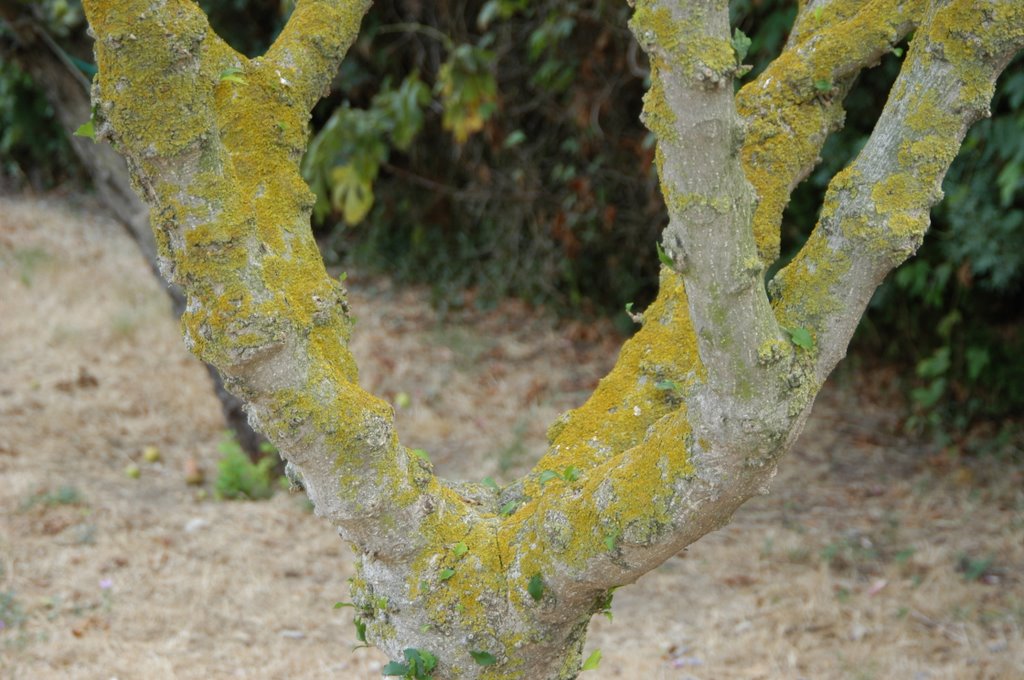
Lichens and algae

The Lichens growing on this mature tree do not present a problem, they are in fact a sign of clean air.

Thursday, April 27, 2006

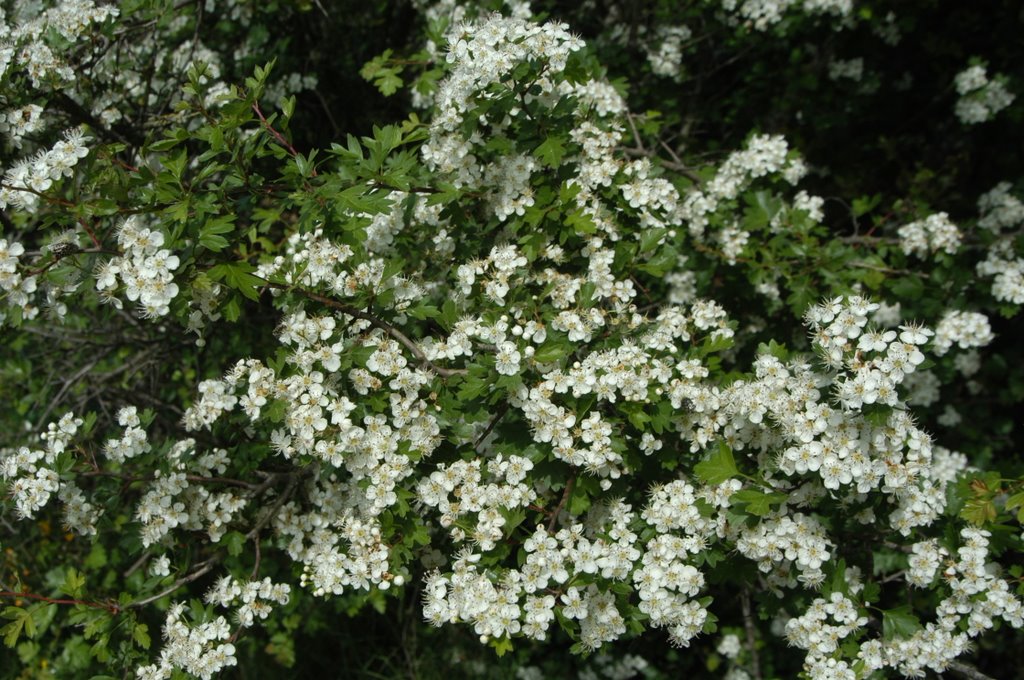
Crown of Thorns


Hawthorn and Blackthorn are two of the spring's heralds, once they bloom you can be sure that 'primivera' has arrived.

This photograph is of a hawthorn which suffered badly in last years drought though now looks to be fully recovered.

Often used as a hedging plant it also makes an excellent tree, the pink form being particularly striking.

Tuesday, June 07, 2005

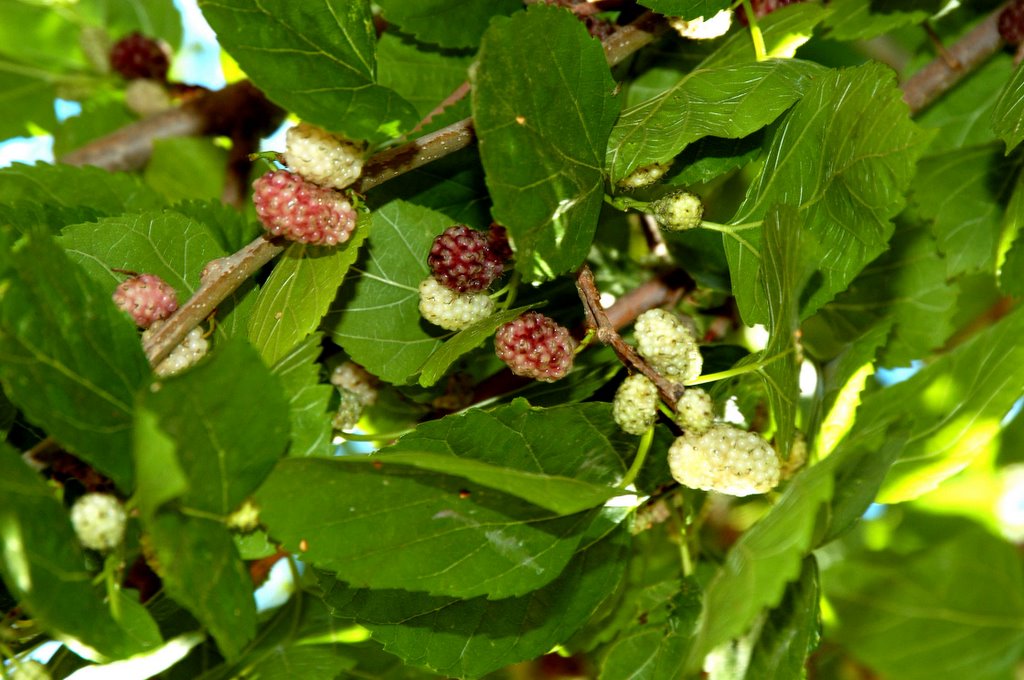
Mulberry fool


The Mulberries are cropping well despite the lack of rain water. The berries are very sweet and they are attracting the attention of the builders as well as the wasps. Not sure yet which will sting me the most!

Frequent gusts of wind shake the over ripe fruit from the branches littering the ground with decaying pulp. This black gunge is walked into the house staining the newly laid tiled floors.
I pick as much as I can use and freeze and leave the rest to the birds, bugs and builders.

The trees grow well here, and I see the fruit being sold in the local supermarkets at 4€ a kilo.
Mulberries have a short season and I am not sure how many people would be needed to pick and market the fruit if I plant more trees.

Just found this button - €, probably going to have to use it a lot from now on! Isn't technology wonderful when it works?