Showing posts with label mediterranean climate. Show all posts

Sunday, November 13, 2011

Reforestation of City Space Milan, Italy

Architects have been struggling with the incorporation of renewable energy components into their projects as demanded by planning authorities. An example being solar panels on tower blocks in city centers. The electricity generated is intended to be used for space heating and ; the problem is that roof space is a relatively small area and incorporating technology into building facades is costly and not always effective.


Stefano Boeri has a different approach in his Vertical forest, Bosque Vertical  


for apartment blocks in Milan, Italy.


Friday, February 25, 2011

Primavera peeps through Mediterranean winter

Spring is definitely in the air, in the garden and surrounding land blossom adorns the branches of the cherry trees and the Hoopoe is claiming territory ready for the breeding season.

Got a head start in the vegetable beds by visiting the supermarket and buying a packet of Thai organic vegetables which were rapidly approaching their sell by date. The bag contained garlic, shallots and lemon grass which I rooted before planting out in the raised beds. The Garlic and shallots are thriving. It might still be a bit cool for the lemon grass but well worth a punt.

It was March the 8th. last year that heavy snowfalls blanketed L'Alt Empordà wiping out power supplies for several days. Hopefully we haven't jumped the gun.

Thursday, February 03, 2011

Grafting citrus fruits -


If you like us are still praying that the winter has been kind to your citrus, here is something you could achieve if you master the green art of grafting. The citrus tree in the picture carries 81 different varieties of fruit, all grafted by Joe Real the owner of the tree. Read his description of what he has achieved and see further photographs by clicking on the link.

Sunday, November 22, 2009

The Lotus of the ancients a tree for today

If you are looking for a large and semi ornamental and fruiting tree to plant in your own Mediterranean Garden, then the European nettle, Celtis australis or the Hackberry as it is commonly known maybe for you. The tree is believed to have been the Lotus of the ancients and has been referred to by both Homer and Tennyson in their writing. Rocks formed during the European Miocene period (between 23.8 and 5.32 million years ago) are found to have traces of the Hackberry. This plant is a therefore a survivor. Modern Mediterranean gardeners will appreciate this plant for its drought tolerance once established. It requires a sunny position and light sandy or loamy soil which is slightly alkaline. The long lived tree produces timber which is prized by wood turners, and a yellow dye can be extracted from the trees bark. Smaller thinner branches are often selected to be walking sticks. The small flowers of the tree are self fertile (hermaphrodite) though pale yellow or green and will produce small edible purple drupes (berries) which can be eaten raw or cooked. The leaves of the Nettle tree are astringent as you may have guessed and have curative properties for stomach disorders. Autumn colour occurs as the leaves turn yellow before falling.

....The mild-eyed melancholy Lotos-eaters came.

Branches they bore of that enchanted stem,
Laden with flower and fruit, whereof they gave....

Lo! in the middle of the wood,
The folded leaf is woo'd from out the bud
With winds upon the branch, and there
Grows green and broad, and takes no care,
Sun-steep'd at noon, and in the moon
Nightly dew-fed; and turning yellow
Falls, and floats adown the air.
Lo! sweeten'd with the summer light,
The full-juiced apple, waxing over-mellow,
Drops in a silent autumn night.
All its allotted length of days
The flower ripens in its place,
Ripens and fades, and falls, and hath no toil,
Fast-rooted in the fruitful soil....

Alfred Lord Tennyson - The Lotus eaters

They went and found themselves 
Among the Lotus-eaters soon, who used 
No violence against their lives, but gave 
Into their hands the lotus plant to taste. 
Whoever tasted once of that sweet food 
Wished not to see his native country more 
Nor give his friends the knowledge of his fate ; 
And then my messengers desired to dwell 
Among the Lotus-eaters, and to feed 
Upon the lotus, never to return. 
                                                              Homer - The Odyssey

Wednesday, December 31, 2008

Mediterranean suprise!

The Costa Brava translates as the Wild Coast. Storms have fashioned the landscape over centuries to produce a series of picturesque rocky coves. This year there have been one or two surprises. 


The beach at Roses looks rather seasonal this year!

FOTOS PATRÍCIA DE GREGORIA I NOEMÍ JARIOD 

          
CALENDARI BOMBERS 09

Two firefighters from Roses where selected for this years calender.


Whilst their colleagues from  Cadaqués just around the Bay of Roses were a little surprised by the effects of the weather!


Saturday, December 13, 2008

"The worst drink"


The documentary The worst shot of climate change is about the rise of temperatures has affected the quality of wine


The rise in temperature causes an early ripening of the grapes. The premature ripening involves changes in the quality of the fruit. On the one hand increases the sugar and other low acidity. This, in practical results, results in wines with higher alcohol content and reduced ability to grow old. 

aume Gramona and Miguel A. Torres is among the few Spanish businessmen who have already begun to adapt to this new reality climate. Gramona makes most of its vintages at night, to get fruit with a temperature lower than the harvest day. Thus, the grapes reach the winery at a temperature that allows the press with greater assurance of quality.Bodegas Torres in carrying out various experiments and initiatives to adapt to climate change. On the one hand improve the methods of wines from indigenous strains, less vulnerable to climate change, and other vineyards planted in areas where rising temperatures before the vine was not profitable. 

Monday, November 24, 2008

Desertification of Spain

Spanish technology to predict the spread of desertification 
- El Mundo 24/11/08
Researchers at the Higher Council for Scientific Research (CSIC) have created an index to measure the desertification that will create risk maps and identify the areas most threatened....
According to the Ministry of Environment, more than two thirds of Spanish territory is potentially affected by land degradation: the entire southern half (with the exception of the highest mountain ranges), the plateau north of the Ebro basin and the Catalan coast . Worldwide, desertification and drought affecting more than 110 countries and threaten the livelihood of over 1,200 million people.According to the United Nations, one third of the land area would be threatened by desertification.

The causes are varied. In general, one can say that is the result of several factors, both natural and man-closely interrelated and influence on the ecosystem causing its gradual deterioration.These include droughts, fires and recurrent irrational use or overuse of soil by man, causing land degradation and loss of biological and economic productivity.

Tuesday, October 31, 2006

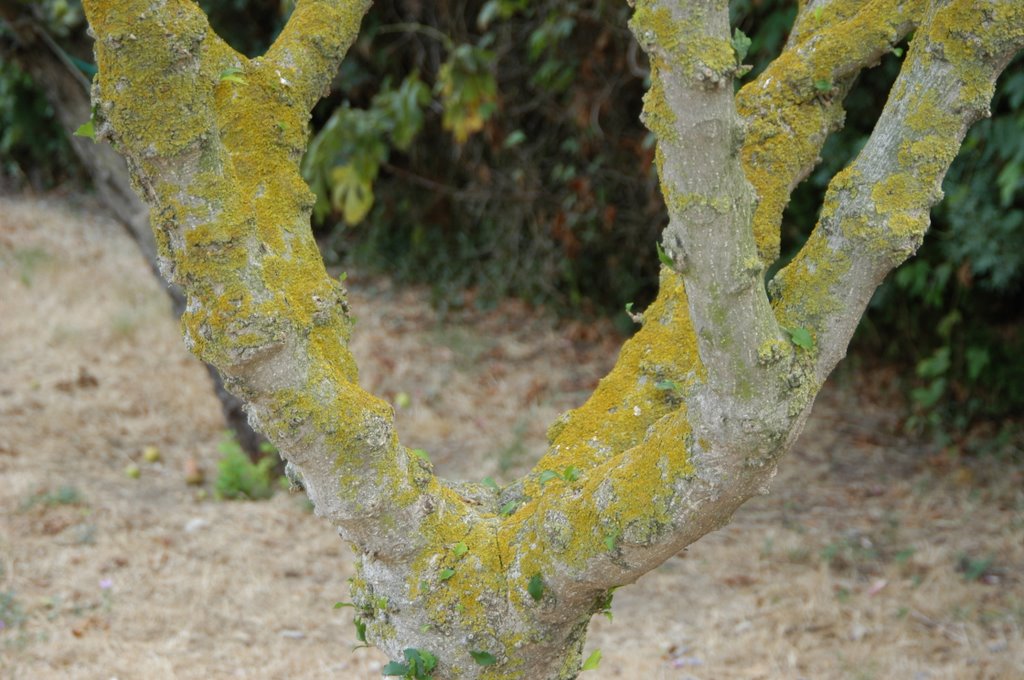
Lichens and algae

The Lichens growing on this mature tree do not present a problem, they are in fact a sign of clean air.

Saturday, April 22, 2006

Monday, March 06, 2006

One step forward two steps back.

It has been an difficult two weeks in the garden. We spent the first of those weeks repairing the damage caused by the wind to our fences. 

Then the area around the trees we planted in the late summer was weeded; a fabric weed suppressing membrane was added and then a rock mulch applied. The rock mulch was made up of the field stones we have dug from the ground, as well as keeping the area weed free it should also help to conserve the water we use.

The 90 km winds that have blown the last three days have destroyed the fencing we erected last week. The joys of Spanish Gardening.

Wednesday, February 08, 2006

A return to relative normality


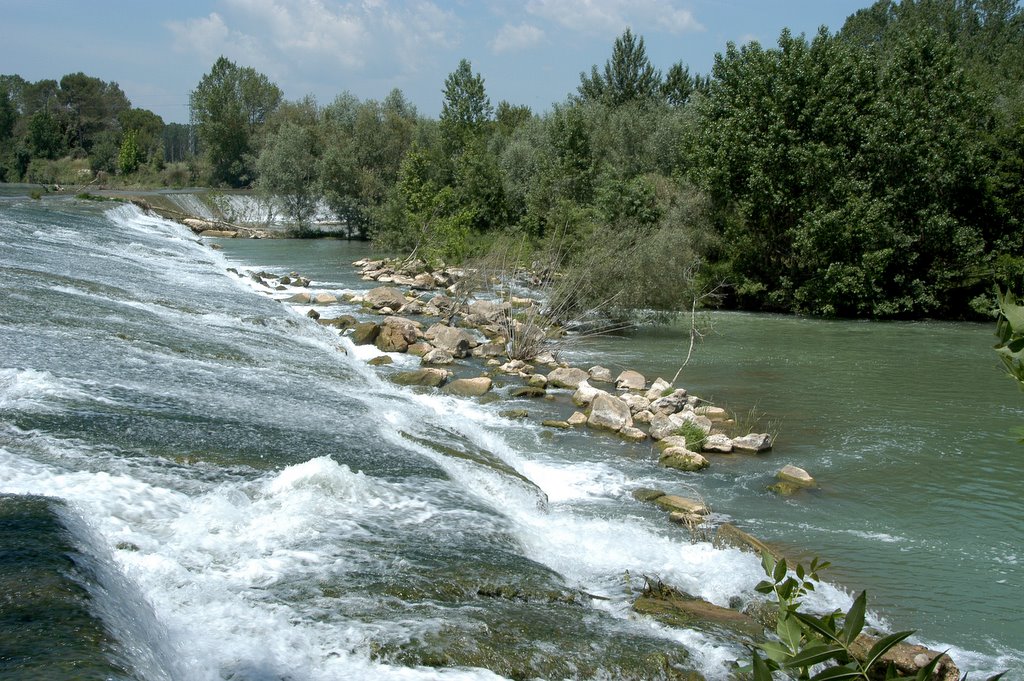
Soon the water falls at Bascara should be looking at their best again, this picture was taken in July 2004 and this image has been just a memory as a result of the drought of 2005. 

The winter rains have now fully replenished the man made lakes, so much rain has fallen in the mountains if not on our still parched land, that the dams controlling the lake have released their excess water into the River Murga.

At least we can water the plants for a while.

Tuesday, October 18, 2005

Rain at last! Thanks Kelvin.


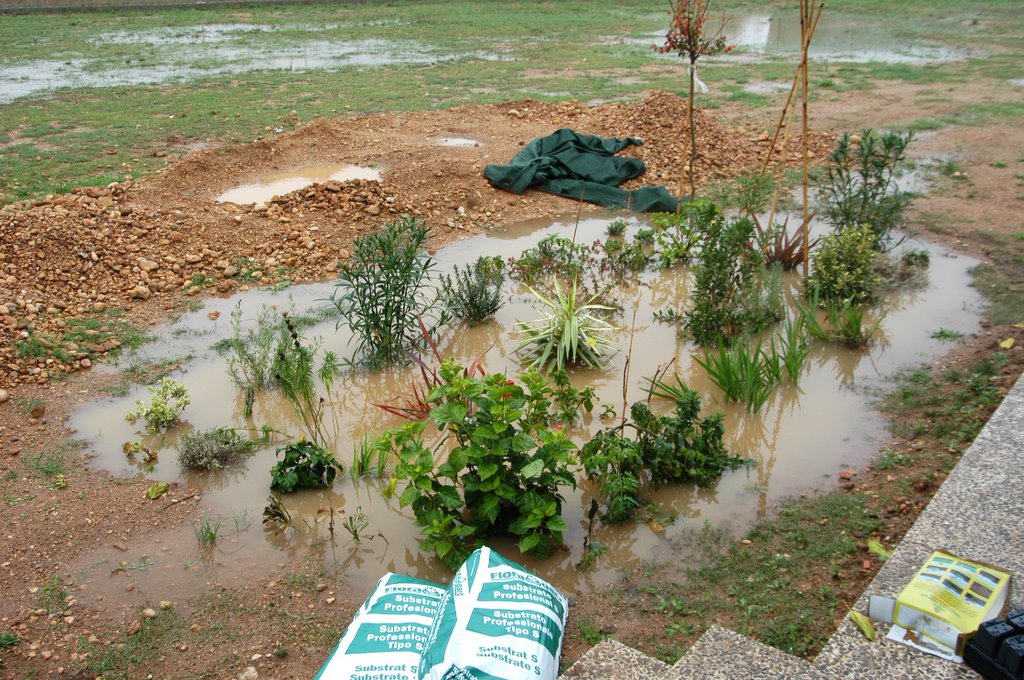
Last night tropical storm Kelvin arrived with a vengeance. Over 272 litres of water per square meter have fallen in past three days. But with the ground so dry much of the rain washed into rivers and then into the sea.

This newly planted nursery bed was underwater for 24 hours.

Mediterranean plants need well drained soil they say.

Saturday, August 20, 2005

Red sky at night Shepherd's delight


The clouds have drifted away south towards Girona and maybe eventually to Barcelona.

 Tomorrow will be another fine day for the tourists on the Mediterranean beaches. 

Here I suspect even the shepherd would be delighted with a little rainfall!