Showing posts with label irrigation. Show all posts

Thursday, September 24, 2009

Sìnia


The Sìnia is an ancient form of well using an Archimedes screw mechanism powered by horse or donkey and was brought to the L´Alt Emporda by the Greeks who settled the area; the name L´Alt Emporda is derived from the greek for market place.

The horse powering this sìnia seemed a bit skitterish and was not easily held by the handler who explained that he was upset at drawing the short straw whilst his stable mates pulled carts around the village as they taxied the visitors to the village centre.

A few examples of the sìnia have been restored and are preserved on the old horta's of VilaBertran, hortas which are still actively farmed and produce high quality fruit & vegetable crops.

Pualanca


Another Greek introduction was the Pualanca a lever mechanism with counter balance to raise water from the well.

The village people (no not them) rather the people of the village enthusiastically demonstrated the water extraction techniques for each new arrival at the show.


Carol was invited to try the Paulanca and was 'well impressed' (pun so obviously intended) with its efficiency though she seemed a little disappointed to learn that modern day pumps lift the water nowadays.

Saturday, December 27, 2008

Trickle down effect

Less than a year ago, the land around this small Senegalese village was parched bush pasture, studded with thick-trunked, knobbly baobab trees.

But over the last six months, ground pockmarked with anthills that lay hard and idle during the nine-month dry season has blossomed through irrigation into a thriving small commercial farm thanks to an aid project funded by Spain.


..."Now there's money in the village," beamed Amy Diouf,

 her baby son strapped to her back, as she stood in fields crossed with plastic irrigation tubes that drip-feed moisture to crops planted at Djilakh farm, 80 km (50 miles) southeast of Dakar.

Friday, November 14, 2008

Autochthonous Planting - Que?

If you live in or visit Catalunya and wondered about the ongoing drought situation and about how it may affect your activities then a visit to the website of 


which will provide the necessary information in Catalan, Castillian or English languages.

 Pictures of depleted reservoirs taken from the web site.


AUTOCHTHONOUS PLANTS ARE MORE SUSTAINABLE?

Rosemary, lavender, thyme and basil are, among others, the local native plants which are best suited to our climate and which consume up to ten times less water than typical seasonal flowers. Moreover, they are more resistant to high temperatures and last much longer.

All parts of society have been contributing for some time to water saving. But we can still improve in making good use of water and confronting the drought. With the advice given in this section we can learn to value it more and reduce our consumption.


How does it affect us?

In Catalonia many months have passed, since the autumn of 2006, without significant rainfall in the headwaters of the rivers, which have only received very light precipitations of less than 10 litres per square metre. This means that it is the worst drought suffered in our country since those of 1944 and 1953.

This situation makes it very difficult to supply water to the different users of this resource and obliges us to prioritise, by law, domestic supply to the whole of the Catalan population.

In the current situation and in accordance with the provisions in the Decree on drought for entering exceptional situation level 2, the uses affected by the restrictions, that is those which cannot use potable water, are:

  • Watering gardens, fields, vegetable gardens, and green spaces and sports areas, either public or private.
  • Washing or damping down streets, roads, paths and pavements, either public or private.
  • Filling of swimming pools, ponds and fountains, private or public.
  • Using hosepipes to wash vehicles except by companies engaged in this activity.


If you want to know if your particular town or village is affected and at which level then you should


Tuesday, November 04, 2008

Welcome waters


The storm filled the reservoirs but  
  rain is elusive in Alt Emporda 

XABIER BARRENA / BARCELONA  & MARIA JESUS IBÁÑEZ / LLEIDA  (translated from El Periodico)

Big week for the Catalans and the reservoirs serving the 5.5 million people who have their water supply based on the river system Ter-Llobregat. In just seven days rainfall the volumes have been stored have risen from 363.4 cubic hecto-metres to 413.1, ie from 59.37% to 67.49%. An increase o 13.68%. Eight more points. 

On this count, however, there is a huge exception: the reservoir of Boadella, in the river Muga. Its figures are still down one tenth, although one tenth up on the records of a week ago, that is, 14 hectometres of reserves and 22.91% of capacity. The River - territory which covers mainly the Alt Emporda - will therefore be in an exceptional state 2. 

The restrictions on water consumption continue, therefore, in force in the region.  

The increase in the storage system that form the basins of the Llobregat and Ter is 49.7 hectometres. Almost the annual expected output of the desalination plant being built in El Prat. The reserves are now at the level of last July and not far from the annual maximum that occurred in June, when they reached almost 70% of capacity. In other words, the consumption of these past four months have gone free.  The comparison with what happened exactly one year ago is even more reassuring. The Ter-Llobregat has more than twice that of water stored in November 2007. Back then, Marsh housed 198 cubic hectometres, 32.5% of capacity, and was heading toward a state of emergency, at 20%.  

EPISODE OF WEEKEND 

The cause of this bonanza water autumn were, above all, two episodes of rain during the weekend, tirelessly recharging  Ter Llobregat. In the reservoir of Sau (in the river Ter), for example, water at a rate of 400 cubic meters per second, 150 cubic meters were registered in The Baells (in the Llobregat) and 90 cubic meters at the Llosa Cavall (in the Cardener, a tributary of the Llobregat). In the city of Girona the flow circulating in half of  the River Ter  is about 3 cubic meters per second.  

In other areas of  Catalunya, the Ebro, Ebro Hydro graphic Confederation (CHE) and the companies that operate hydroelectric dams in the Pyrenees closed their gates yesterday, after spending the entire weekend easing the swamping waters located in the headwaters of the Segre, The Noguera Ribagorçana and Pallaresa Noguera, before the major flood flow experienced by these rivers.  

EARNINGS PYRENEAN 

In just one week, the  Pyrenean reservoirs gained 89 hectometres of water, allowing them to increase their reserves by 4.8%.  Those responsible for the regulation of wetlands remain alert however, the forecast is for further rain and the possibility that, if temperatures go up, it triggers a sudden melting of the abundant snow fall, which fell in the mountain area during the last few days. 

The delegate of the Government of the Generalitat in Alt Pirineu i Aran, Victor Orrit, admitted yesterday that local authorities are on notice, given the risk of new avenues of water. However, the margin for maneuver available to the CHE is still quite broad. Pyrenean reservoirs, which before the current episode of rainfall were around 57% of its capacity, are still at 61.52%. 

The largest increase was recorded in the basin of the Segre, where the dam of Oliana (Alt Urgell) has gained 33 cubic hecto-metres of water and of Rialb (Noguera), and others another 14 cubic hecto-metres.  All this is a consequence of the dramatic rise recorded by the river last Sunday, when the river flowed on its way through Organyà  at 112 cubic meters of water per second, a flow rate multiplied by 10 over the normal readings. 

Tuesday, October 24, 2006

Connecting the irrigation tube.


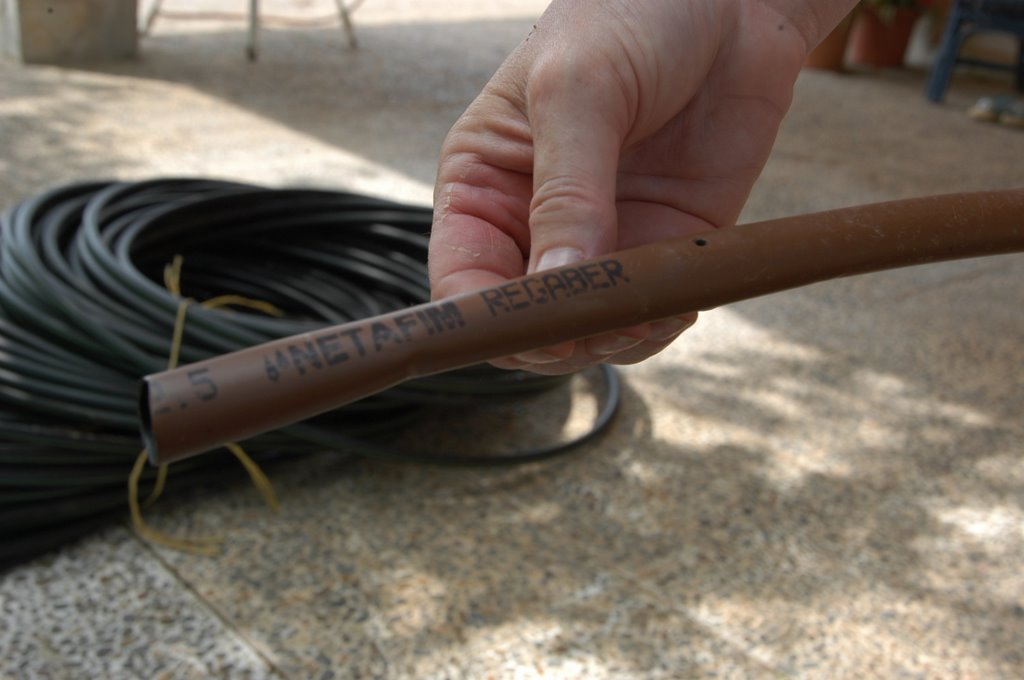
Here Carol is demonstrating the connection of a tee shaped piece to a perforated tube. The small blue ring is an olive which seals the joint, it is important to push the tube all the way up to the bottom of the tee piece seen here under Carol's middle finger.

Tubes for automatic watering system.


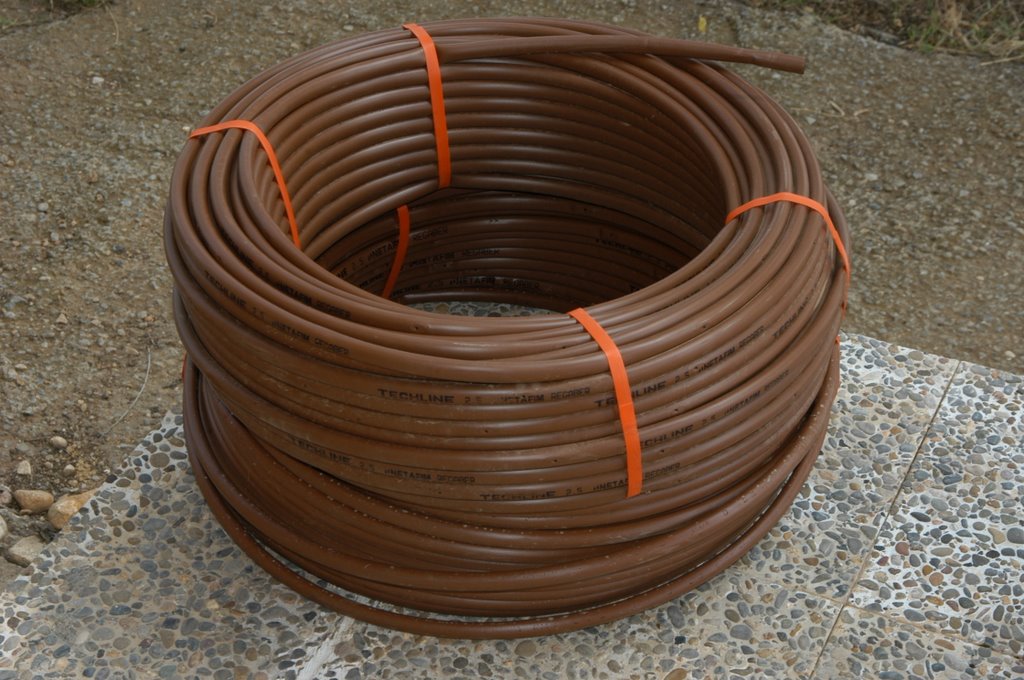
This is the pipe used for the automatic watering system, you can buy the pipe by the meter.

The brown coloured tube on the left is pre- perforated and is useful for bedding schemes and densely planted borders.

Black coloured tube comes in both perforated and un-perforated forms. Here I intend to use an un-perforated tube, which allows me to bury it between the planting schemes.

The un-perforated tube is also useful in irregularly planted areas where you simply cut a small hole using a designated tool; and then affix a smaller distribution tube to your plants.

Components automatic watering system.


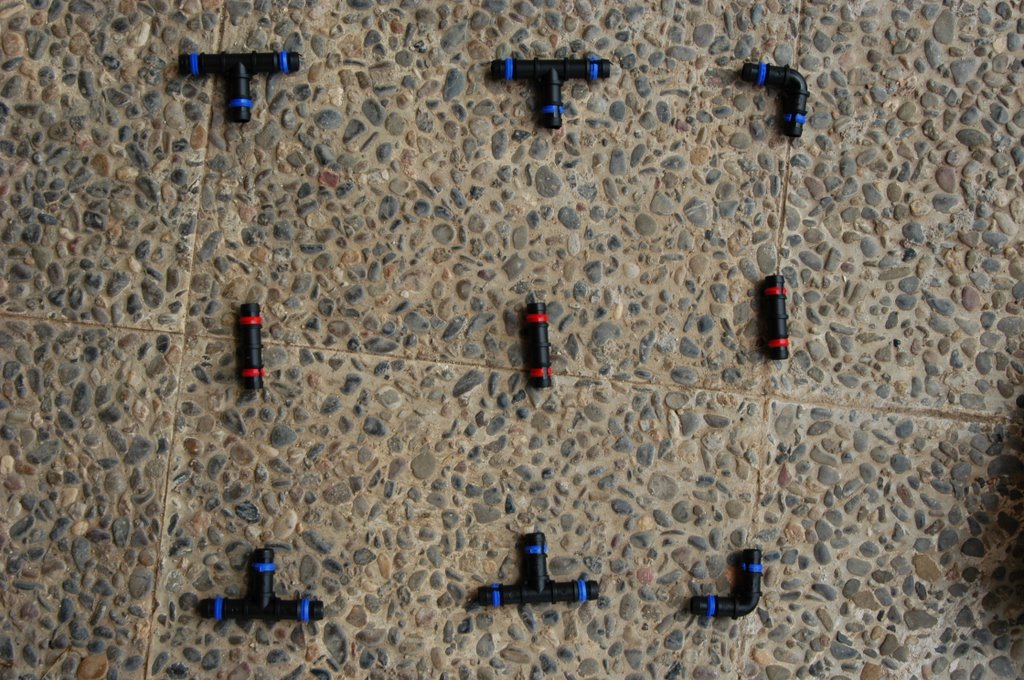
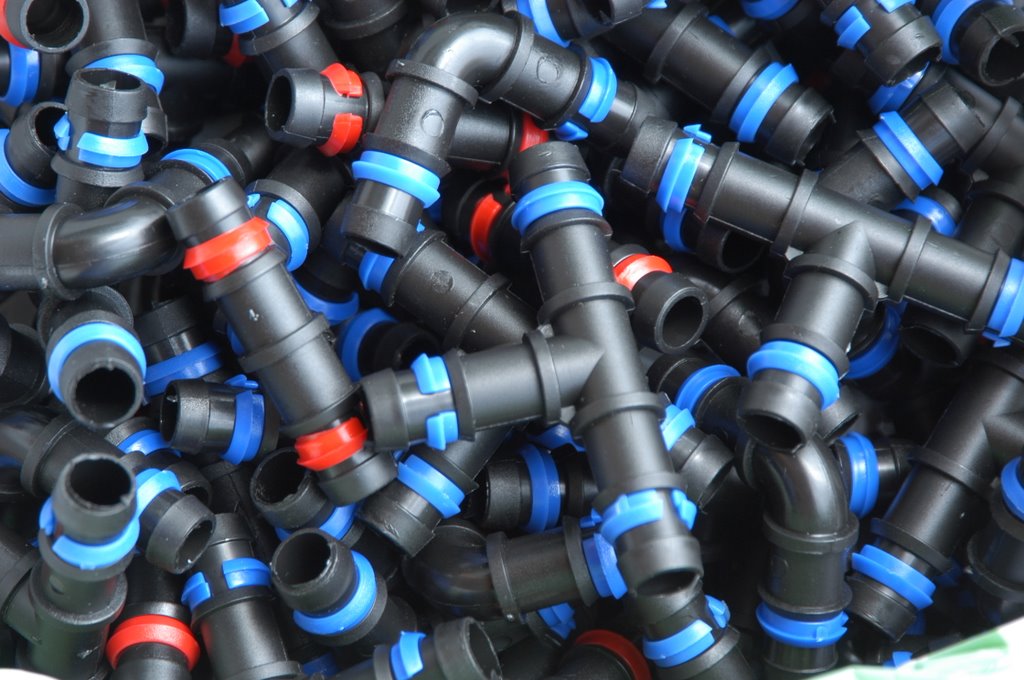
The components shown above are used to link the water pipes together and are designed to 'push- fit'.

They comprise a straight connector, a right angle and an equal tee. 

Using those pieces it is fairly easy to make a series of grids to distribute the water.

Automatic watering system.


Before next summer we will install an automatic watering system throughout the garden. 

This years heat took a toll not only on the plants but also on ourselves through the fetching and carrying of watering cans and the hauling of the host pipe from pillar to post.

The continuous drip system is more efficient than the manual system we currently employ and with water prices rising fast that should also mean there are savings to be made.

Wednesday, September 13, 2006

All or nothing


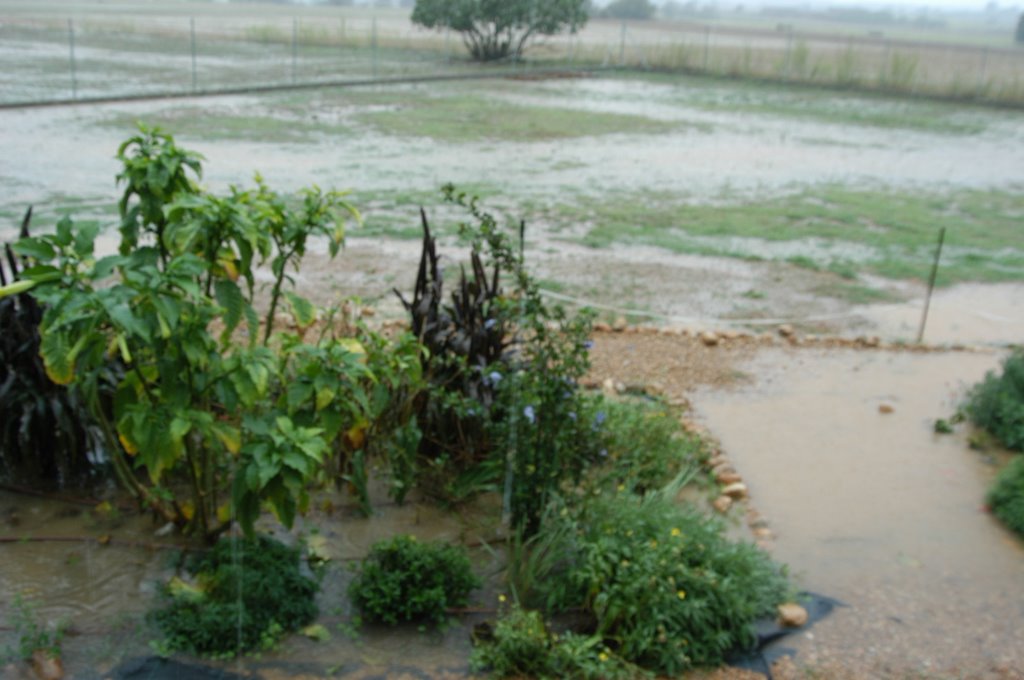
The rain has returned with a vengeance and the garden is once more under water, here I was trying to lay irrigation pipes for the automatic watering system and, just like washing your car, this seems to have started the rain. 

The trouble is it's the wrong sort of rain. What we need is what the Irish call 'soft rain'.

Wednesday, June 08, 2005

Water wagon ho!


Rain is now something that only happens in other countries.

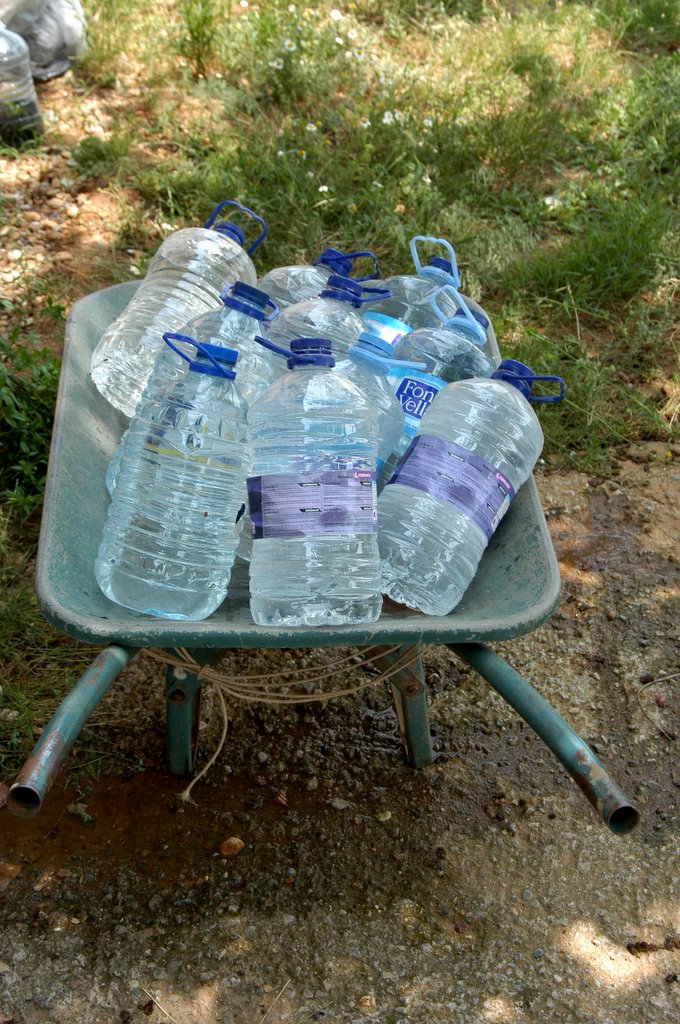
Transporting water to the far end of the finca twice a day , trying to keep the young Olive trees alive. Nine five litre water bottles almost fit comfortably into my wheelbarrow. Once the bottles deteriorate I cut the tops off and use them as plant pots, at the end of the growing season they go to the recycling facility to be reborn as water containers etc.