Showing posts with label Europe. Show all posts

Tuesday, February 11, 2014

Free app test your garden with Mysoil app

mySoil App | Growing our knowledge

mySoil

App | Growing our knowledge

mySoil gives you access to a comprehensive European soil properties map within a single app. Discover what lies beneath your feet and help us to build a community dataset by submitting your own soil information.
itunes badgeGoogle PlayAmazon

mySoil Reviews

‘Fantastic to have this information in the palm of your hand when you're on site.’
Dean Morrison
‘This is a really interesting App. While of great practical use to gardeners, it also a gives a fascinating insight into where geological changes take place.’
TrickyOnWhat
‘Excellent little free app. Informative and helpful and has been useful for gardening by telling me soil type and ph.’
Nogbad the bad


Partnership

mySoil has been made possible through collaboration with several major research organisations, including:
CEH logo
MET office logo
EU logo

European coverage

Discover the latest soil mapping data from across Europe.
More detailed data is available for UK.

Soil information

Learn more about the soil beneath your feet with up-to-date information; including soil pH, texture, depth, organic matter and temperature.

Citizen science

mySoil need your help!

Join our growing community by submitting your own soil data to help us better understand this precious resource.

Sunday, February 06, 2011

GM lobby opens door to EU food chain


Photograph: Martin Argles for the Observer

Genetically modified crops will be allowed to enter the UK food chain without the need for regulatory clearance for the first time under controversial plans expected to be approved this week....

Relaxing the EU's zero-tolerance position would greatly benefit US feed exporters. The push for Europe to drop its zero-tolerance policy began in 2009 after EU authorities found traces of GM maize in soy shipments from the US and refused to allow its entry. Such recalls are expensive and those affected are unlikely to receive compensation.

GM supporters warn that the current zero-tolerance policy could result in a dramatic shortage of feed for livestock. But critics dismiss the claims as scaremongering and say there is no evidence to back up them up.

"This is a solution without a problem, and the price could be very high indeed when unknown genetically modified organisms are let loose in the food chain," said Eve Mitchell, food policy adviser at Food and Water Europe, a campaign group.

"Rather than ignoring EU food safety laws to help the US soy industry cut costs, we should simply buy the stuff from countries that segregate their GM properly. If it hasn't been tested, why eat it?"

Many of the GM crops, notably soy and maize, that have been found in animal feed imported into Europe are resistant to multiple herbicides. Critics blame these new GM crops for the recent rise of "super weeds" across vast tracts of the US farm belt.

Friends of the Earth Europe said it had obtained expert legal advice questioning the legality of the EU's plan. But European regulators believe that allowing the import of animal feed containing no more than 0.1% of GM traces does not jeopardise food security.

Jamie Doward

Monday, December 20, 2010

“Som lo que Sembrem” - We Are What We Sow


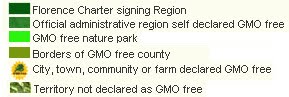
The map shows towns and regions in Spain which are rejecting Genetically Modified crops (GMO)

Som lo que Sembrem” (We Are What We Sow)

Wiki Leaked

Catalonia and the Basque Country, continue to seek more autonomy viaa vis the central government.

In March 2008, the Canary Islands were declared GM-free. Since fewer than 1,380 acres of corn are
grown in the Canaries, this is considered mostly a symbolic gesture.

However, on February 5, 2009, an initiative was
proposed in the Catalonian Regional Parliament to declare the region GM-free. The initiative has not yet come up for a vote, and its prospects are uncertain. Such an action would be cause for serious concern, since Catalonia is a center of GMO corn cultivation.

More recently, on April 21, 2009, the Basque Parliament passed stringent biotech coexistence legislation which could likely force farmers to halt planting of MON810 due to strict compliance issues. The Spanish
Association of Biotechnology Industries (ANOVE) will challenge the Basque legislation.

Sunday, April 12, 2009

Seismic Spain


Seismic activity is not unknown in Spain and the recent events in Italy will have many people wondering about the likely hood of experiencing the effects of an earthquake. We live close to a volcanic region near to the city of Olot.

Emilio Carreno, director of the National Seismic Network is quoted in today's El Mundo, he says that,

"The Mediterranean is an area of seismic importance" because it is a contact zone between the African and European plate, adds Mercedes Ferrer Gijón, the Geological and Mining Institute of Spain, 'but while Turkey, Greece and Italy have a risk seismic high in Spain is moderate or low. "

It is in the southeast, especially Grenada, Murcia and Alicante and in the Pyrenees where underground activity is most intense and where most earthquakes are recorded.

Friday, January 02, 2009

Europeana Cultural digital database


Students of European Arts and History may be interested in visiting the relaunched digital archive that is known as Europeana. 


Within Europeana you can search through millions of digital items provided by Europe's museums and galleries, archives, libraries and audio-visual organsiations.

Searching in Europeana is simple. Just ask yourself whowhatwhere or when you are interested in and type these words into Europeana's search box. If you are stuck for ideas try:

  • Who: Names of actors, authors, architects, artists, choreographers, composers, conductors, dancers, film directors, musicians or photographers.
  • What: Words from titles of books, poems, newspapers, paintings, photographs, films or television programmes.
  • Where: Names of towns, cities or countries within Europe or around the world.
  • When: Dates (e.g. 1945) such as the year you were born in or a famous date in history or a period (e.g. Roman or Medieval).

Using the advanced search you can search specifically for words in titles, for names of creators (e.g. authors, artists, musicians etc.) or dates (e.g. 1945). Alternatively you can combine your search terms (e.g. title: hamlet and date: 1983).