
Thursday, December 30, 2010


Saturday, December 27, 2008
Hyroelectricity and irrigated land in Spain
MADRID (Reuters) - Spain's capacity to generate hydroelectricity and irrigate crops has risen in the past week, the latest official data show, but levels are still far below average in a country that depends heavily on imports of grain and gas.
Reservoirs held enough water to produce 8,571 gigawatt-hours of hydropower, according to the Ministry for the Environment and Rural Affairs, or 202 GWh more than a week ago.
That compares to typical demand of 740 GWh on a working day at this time of year and is 86.3 percent of the average available over the past 10 years.
Hydroelectric output so far this year in Spain has fallen by 20.1 percent from the same period in 2007, data from national grid operator REE show, after long periods of drought which prompted the city of Barcelona to import water by sea.
Gas-powered generators have helped fill the gap by boosting production 35.4 percent, and in consequence gas distributor Enagas forecasts demand in Spain will rise this year by 10-12 percent to 43.5 billion cubic meters.
Spain imports more than 99 percent of its gas and is the world's third largest buyer of liquefied natural gas via six regasification plants. Its main supplier is Algeria.
IRRIGATION LEVELS RISE
The Ministry logged rainfall of 3.1 millimeters in the week to December 21, or just 19 percent of the historical (1930-96) average.
Even so, reservoirs for consumption -- including farm use -- rose to 41.1 percent of capacity from 40.5 percent a week ago, although that was just 49.3 percent of the 10-year-average.
Crops like maize need irrigation to grow in Spain's harsh climate and the country can never grow enough grain to meet its needs, particularly from an intensive livestock sector.
Last year, Spain imported more than 12.2 million tonnes of grain, but traders say this may fall to 7.5 million in the market year which began in July due to a crisis amongst livestock farmers.
The current maize harvest is behind schedule but not in doubt, although farmers have said they may sow less wheat and barley this winter due to low water levels, tumbling prices and higher costs.
Other important irrigated crops in Spain include cotton and alfalfa, which is an ingredient in animal feed.
(Reporting by Martin Roberts; editing by James Jukwey)
Tuesday, November 25, 2008
Who has seen the wind?

Wind power supplied a record 43 percent of all electricity demand in Spain, which is being lashed by heavy winds and rain, for a brief period on Monday, the Spanish wind power association said.
Spanish wind farms generated 9,253 megawatts of the total demand of 21,264 megawatts at around 5 a.m. (0400 GMT), a moment when energy useage was low because most Spaniards were still asleep, it said in a statement.
The previous record of 40.8 percent was set in March, also during a stormy day.
Wind power generated a maximum of 10,263 megawatts in Spain shortly after noon on Monday, compared to the production record of 10,880 megawatts set in April.
The energy source will likely account for nearly 11 percent of all electricity demand in Spain during all of 2008, the association said.
Spain, along with Germany and Denmark, is among the three biggest producers of wind power in the European Union. It aims to triple the amount of energy it derives from renewable sources by 2020.
City lights
A Spanish city has found an unusual place to generate renewable energy - the local cemetery. Santa Coloma de Gramanet, near Barcelona, has placed 462 solar panels over its multi-storey mausoleums. Officials say the scheme was initially greeted with derision, but families who use the cemetery eventually supported the idea following a public campaign. There are now plans to erect more panels at the cemetery and triple the amount of electricity generated. The cemetery was chosen for the project because it is one of only a few open, sunny places in the crowded city, which has a population of 124,000 crammed into 4 sq km (1.5 sq miles). The installation cost 720,000 euros (£608,000) but will keep about 62 tonnes of carbon dioxide out of the atmosphere every year, said Esteve Serret, a director of Conste-Live Energy, the company that runs the cemetery and also works in renewable energy. "The best tribute we can pay to our ancestors, whatever your religion may be, is to generate clean energy for new generations," he said. | |

Sunday, November 23, 2008
Mas Sol i Vent - Catalunya

Jan and Steve have bought a Finca in the Terra Alta region of Catalunya. They are a resourceful couple and are developing a Mediterranean Garden despite the fact that their large plot came without either a water or power supply.

Saturday, September 06, 2008
The bigger picture smaller trees
The Catalan region is currently subject of a popularist campaign to stop the construction and installation of a high voltage power cable (400kw) over the
Trees are often quoted as a sustainable resource, but the removal of a large volume of mature trees, even when a similar number of younger trees are planted to replace them, must have significant impact on the quality of the environment
Monday, August 02, 2004
Electrickery

On buying the house we saw that there was a problem with the electric supply. The three phase electric supply had been severed when a wall was built to divide the plot between this house and adjacent factory.
The owner assured us that the new cable would be installed prior to us taking over the house he even showed us the cable. Needless to say when we flew out to Spain to sign for the house the cable was not installed. After negotiations via the agent a heavy digger was brought in and the cable installed that was the good news. The bad news was that we would have to wait until September for the electricity meter to be moved. It was August and Spain was on holiday!
Update 2006 we are still waiting for the meter to be connected! Despite constant reminders to those concerned.
After 18 months the meter was moved to its new location just a few yards away from where it started out. The job took two men, two screwdrivers and 15 minutes. The explanations about who had been waiting for who to do what were incredible. The incompetence incredible.
Sunday, July 25, 2004
Piedra
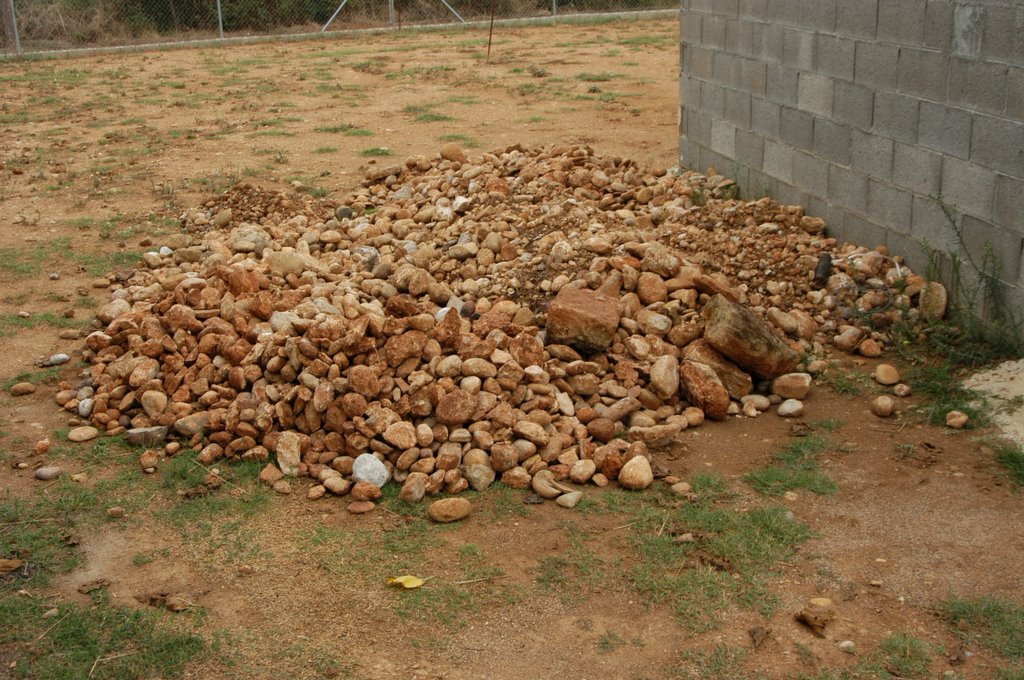
These are just a few of the field stones, which were embedded in the soil, that we removed by hand.
Barrow load after barrow load. It might be possible to utilise them in the creation of paths and garden features.
Piedra the local name for the rock is derived from Peter the rock on which Christ would build his church.
Many local builders utilised the rock in their construction technique. The rock which is quite soft crumbles in time making some of the buildings look even older than the are. Many of the villages can trace their history back to the middle ages which were also known as the 'dark ages'. I prefer to use the term 'dark ages for the present time because we have a dodgy electricity connection.